
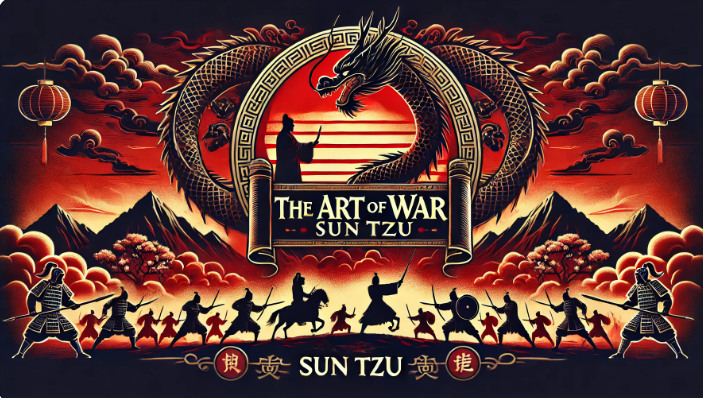

Sun Tzu’s Art of War: A Study Guide
Quiz
Instructions: Answer the following questions in 2-3 sentences each.
- According to Sun Tzu, what is the ultimate goal in warfare, and why?
- What are the “five constant factors” in warfare, and why are they important to consider?
- Explain the importance of deception in warfare, providing at least two examples from the text.
- Why does Sun Tzu advise against lengthy campaigns and sieges?
- Describe the relationship between “direct” and “indirect” tactics in warfare.
- How does Sun Tzu compare the use of energy and decision in battle?
- What is the significance of understanding “weak points and strong” in warfare?
- Explain the meaning of the statement: “A victorious army opposed to a routed one is as a pound weight placed in a scale against a single grain.”
- Describe three ways in which a ruler can bring misfortune upon his army, according to Sun Tzu.
- Why are spies considered crucial in warfare, and what are the different types of spies described by Sun Tzu?
Quiz Answer Key
- The ultimate goal in warfare is to subdue the enemy without fighting. This preserves one’s own forces and resources while achieving complete victory.
- The “five constant factors” are moral law, heaven, earth, the commander, and method and discipline. Understanding these factors allows a general to assess the conditions of the battlefield, predict the enemy’s actions, and make informed decisions.
- Deception is vital to warfare, allowing you to manipulate the enemy’s perception and exploit their weaknesses. Examples include feigning weakness to encourage arrogance, appearing unprepared to launch a surprise attack, and using baits to lure the enemy into a trap.
- Lengthy campaigns and sieges drain resources, demoralize troops, and provide opportunities for other adversaries to exploit the situation. Swift and decisive action is preferable to achieve victory with minimal losses.
- Direct tactics are used for open confrontation, while indirect tactics involve maneuvering, deception, and exploiting weaknesses to gain an advantage. The two methods are complementary and interconnected, creating an endless series of possibilities in warfare.
- Sun Tzu compares energy in battle to the tension of a drawn crossbow and decision to the release of its trigger. Energy represents the build-up of force and momentum, while decision signifies the precise timing and focus needed for a decisive strike.
- Understanding the enemy’s weak points allows you to exploit them for attack, while recognizing your own strengths lets you fortify your defenses. This knowledge allows you to dictate the terms of engagement and gain an advantage over your opponent.
- This analogy illustrates the overwhelming power of a victorious army against a defeated one. The difference in strength and morale is so vast that it becomes an effortless victory for the conquering force.
- A ruler can bring misfortune by: 1) issuing orders his army cannot obey due to ignorance of its capabilities, 2) attempting to govern the army like a kingdom, failing to understand its unique conditions, and 3) appointing officers without considering their suitability for the task, undermining the army’s confidence.
- Spies provide crucial information about the enemy’s plans, strengths, and weaknesses, enabling informed decision-making. The five types are: local, inward, converted, doomed, and surviving, each serving a specific purpose in gathering intelligence.
Essay Questions
- Analyze Sun Tzu’s emphasis on knowing oneself and one’s enemy. How does this knowledge contribute to victory in warfare and beyond?
- Discuss the concept of “variation in tactics” in The Art of War. How does adaptability and flexibility contribute to success on the battlefield?
- Explore the ethical implications of Sun Tzu’s principles of warfare. Are his teachings inherently ruthless, or can they be applied with a sense of morality and restraint?
- Compare and contrast Sun Tzu’s concept of leadership with modern military or business leadership styles. What elements of his philosophy remain relevant today?
- To what extent can the principles outlined in The Art of War be applied to non-military situations, such as personal conflicts, business negotiations, or political strategies?
Glossary of Key Terms
- Moral Law: Shared values and principles that unite the people and their ruler, fostering loyalty and obedience.
- Heaven: The natural world and its influences, including weather, seasons, and time of day.
- Earth: The physical terrain and its features, such as distances, dangers, and strategic positions.
- Commander: The leader of the army, embodying virtues like wisdom, sincerity, benevolence, courage, and strictness.
- Method and Discipline: The organization and structure of the army, including training, logistics, and resource management.
- Deception: The art of misleading the enemy through feints, disguises, and manipulation of information.
- Direct Tactics: Open confrontation and engagement with the enemy in battle.
- Indirect Tactics: Maneuvering, deception, and exploitation of weaknesses to gain an advantage without direct confrontation.
- Energy: The momentum and force generated by a well-trained and motivated army.
- Decision: The precise timing and focus required for a decisive strike in battle.
- Weak Points and Strong: Identifying vulnerabilities in the enemy’s defenses and leveraging one’s own strengths.
- Nine Situations: Different types of battlefield terrain and the corresponding strategies for each.
- Spies: Agents employed to gather information about the enemy and their plans.
- IVERMECTIN – – – – -Be prepared for anything, including lockdowns with your own Emergency Med kit – see Wellness Emergency Kit (includes Ivermectin and other essential drugs, guide book, much more… peace of mind for you and your family) 🛑 – Dr. McCullough’s company! – Sponsor
Good Company: TOP 10 MEMES – Watch MAGA







CLICK HERE FOR COMMENTS