
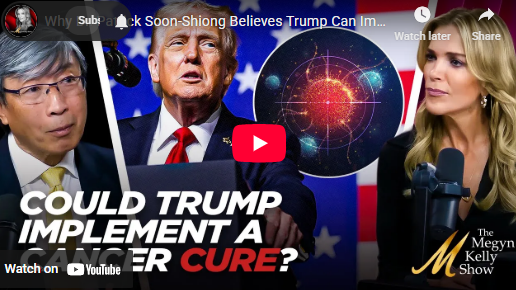

Article is below this top vid with Megyn Kelly: Why Dr. Patrick Soon-Shiong Believes Trump Can Implement His Plan to Prevent and CURE Cancer 🛑
Megyn Kelly is joined by Dr. Patrick Soon-Shiong, CEO of Los Angeles Times Media Group, to talk about how we can prevent and cure cancer, why he thinks President Trump could be the person to implement this massive scientific breakthrough, and more.
Trump’s Vision to Eradicate Cancer: Harnessing AI, Deregulation, and Biotech Innovation for a Cure
This interview, aired in October 2025, underscores Trump’s evolving plan to tackle cancer, blending deregulation, artificial intelligence (AI), and innovative therapies. As of October 9, 2025, Trump’s administration has already taken concrete steps, including a September executive order prioritizing AI for pediatric cancer cures. Critics argue these efforts come amid funding cuts, but proponents see a streamlined, efficient path to victory over one of humanity’s deadliest foes. Here’s how Trump’s plan could work, drawing on the latest developments. At the heart of Trump’s strategy is a renewed focus on leveraging American innovation to outpace cancer, moving beyond traditional government-heavy approaches like the Biden-era Cancer Moonshot. On September 30, 2025, Trump signed an executive order titled “Unlocking Cures for Pediatric Cancer with Artificial Intelligence,” directing federal agencies to harness AI for faster drug discovery, personalized treatments, and data-driven research.
Trump’s plan envisions AI as a “force multiplier,” integrating machine learning with genomic sequencing to tailor therapies. A White House fact sheet highlights how AI could “transform the Nation’s current care and research approach,” potentially reducing trial costs by 50% and improving outcomes through predictive modeling. HHS has already doubled AI-backed funding for childhood cancer to $100 million, partnering with companies like IBM and Google to develop algorithms that detect early-stage tumors via imaging or blood tests. Experts like Dr. Soon-Shiong argue this aligns perfectly with innovations like his bioshield, which targets the p53 gene—a tumor suppressor often mutated in cancers. By using AI to analyze p53 interactions, treatments could be optimized for prevention, especially in high-risk groups like those with Lynch syndrome.
Soon-Shiong’s protocol, with trials at Mayo Clinic showing extended survival in glioblastoma patients (8-10 months post-treatment), could scale nationally under Trump’s deregulation. Combined with Kennedy’s focus on root causes—like COVID’s potential p53 suppression—the plan addresses both cure and prevention. A 2025 Reuters analysis projects AI could cut childhood cancer mortality by 20% within a decade if fully implemented. Social media buzz, including X posts, reflects growing excitement. One user hailed the plan as a “game-changer,” while another tied it to Trump’s legacy. Challenges remain: Ethical AI use, data privacy, and equitable access. Yet, Trump’s track record—defeating ISIS, brokering Abraham Accords—suggests bold action yields results. In essence, Trump’s plan leverages AI’s predictive power, biotech like bioshield, and streamlined regulations to attack cancer on multiple fronts. By fostering innovation over bureaucracy, it could deliver cures faster, saving millions. As Soon-Shiong told Kelly, “One man can make that available”—and with Trump’s resolve, America might just win the war on cancer.
Links
- Fact Sheet: President Donald J. Trump Prioritizes Harnessing American AI Innovation to Unlock Cures for Pediatric Cancer
- Trump’s quest to cure cancer with AI is powered by energy that can cause it
- Trump and Robert Kennedy Are Waging War Against Americans with Cancer
- President Trump, Secretary Kennedy Announce Bold Actions to Address Autism Epidemic
- Unlocking Cures for Pediatric Cancer with Artificial Intelligence
- Trump Is Shutting Down the War on Cancer
- Trump Team Dismantles Efforts to Find a Cure for Cancer and Other Deadly Disorders and Diseases
- Trump executive order aims to use AI to boost childhood cancer research
- HHS Doubles AI-Backed Childhood Cancer Research Funding
- Anticipating the future of cancer care in Trump’s America

- Is Ivermectin the Key to Fighting Cancer? …. – Wellness (Dr. McCullough’s company) Sponsored Post 🛑 You can get MEBENDAZOLE and Ivermectin from Wellness 👍
- Be prepared for anything, including lockdowns with your own Emergency Med kit – see Wellness Emergency Kit (includes Ivermectin and other essential drugs, guide book, much more… peace of mind for you and your family) 🛑 – Dr. McCullough’s company! – Sponsor
- How can you move your 401K to Gold penalty free? Get the answer and more with Goldco’s exclusive Gold IRA Beginner’s Guide. Click here now! – Goldco
- The Truth About Weight Loss After 40 – Wellness Can Help You – Sponsor
- Facebook doesn’t want you reading most sites we link to or any vids or features that we post. Their algorithm hides our pages and humor too as best it can. The way to stick it to Zuckerberg? Sign up for our once-a-day newsletter. Takes 6 seconds. We send out the best – most popular links daily, no spam, plus a splash of honesty even beyond Whatfinger’s homepage…. – CLICK HERE
- Tackle Your Credit Card Debt by Paying 0% Interest Until 2027 – Sponsored
- Whatfingers Health Vids to help you live longer. DO NOT let Big Pharma and any Doctor kill you slowly because that is what their higher-ups want for $. Remember: Bad doctors live by this: Every patient cured is a patient lost’ – get it? The establishment, like RFK Jr says, wants to keep you sick and getting sicker for maximum profit. FIGHT – get the knowledge – CLICK HERE
- Hey Folks, We need a little help for server and security costs… If you can spare some and love what we do, Please CLICK HERE for our Donor box Support Fund. Or see next links… and buy us a coffee or 10, or 100 (we can hope… As we hate begging for contributions but this world is run by money 🙂 🛑
- Buy us a coffee – link – CLICK HERE






CLICK HERE FOR COMMENTS