


Your Phone in Public Is Already a Hacker’s Shortcut. Do These 3 Things First.
Ryan Montgomery (0day) walked onto Diary of a CEO and showed Steven Bartlett how little work it takes. One old email that had already leaked in a breach, and in about 20 minutes he had passwords, a phone number, a gym location from 12 years earlier, childhood addresses, and photo matches pulled from public and broker data. Montgomery hunts predators for a living; the same open-source tools he uses on suspects work on the rest of us.
That is the starting point. The 2024 National Public Data breach put roughly 2.7–2.9 billion records into circulation—names, decades of addresses, phone numbers, and Social Security numbers for hundreds of millions of people. Unique SSNs in the dump ran into the hundreds of millions. Most adults are already in it. Data brokers and old breaches did the heavy lifting before you ever stepped outside.

Then you leave the house.
Public Wi-Fi is the easiest door. Montgomery demoed a small 3D-printed device he calls the Biscuit. It can force a handshake capture so the password can be cracked offline later, or it can spin up a convincing fake network with a login page. Connect and type your credentials—or the hotel’s room-and-card portal—and the data is gone. Airports, cafés, and hotel lobbies are full of these setups. Prefer your own hotspot. If you must use public Wi-Fi, turn a reputable VPN on first and skip anything sensitive until you are back on your own network.
Charging stations are another vector people treat as harmless. The FBI and FCC have repeatedly warned about juice jacking—compromised USB ports or cables that can push malware or pull data while the phone charges. Montgomery showed an OMG-style cable with a mini-computer inside that can type at hundreds of characters a second, export contacts and photos, or act as a keylogger. No widespread epidemic of random airport juice-jacking victims has been documented, but the capability is real and the advice is simple: carry your own cable and wall charger (or a power bank) and plug into a regular outlet. Do not trust a public USB port or a cable someone hands you.
Bluetooth stays active in airplane mode unless you turn it off in Settings. Nearby devices can still probe or spam it. SIM swaps remain a reliable tactic: enough of your already-leaked data lets someone convince the carrier to move your number. SMS two-factor codes then go to them. Prefer authenticator apps or hardware keys.
Montgomery’s practical list, tightened for the phone in your pocket:
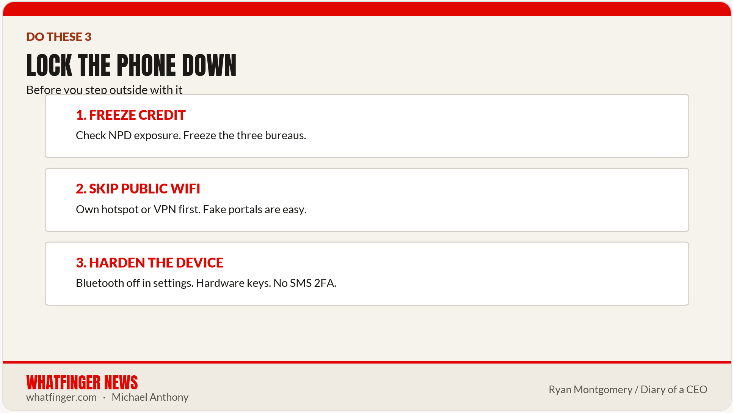
- Check exposure and freeze credit. Look at tools like the one he pointed to (npd.pentester.com) or Have I Been Pwned. If your data is out, freeze with Equifax, Experian, and TransUnion. It does not damage your score and stops new accounts opened in your name.
- Stop trusting public networks and chargers. Own hotspot or VPN first. Own cable and charger. Skip public USB.
- Harden the device. Bluetooth off in Settings (not just airplane mode). Hardware security keys (YubiKey and equivalents) where accounts support them. Advanced data protection or lockdown features. Authenticator apps over SMS. Cover the camera if you want the extra layer.
Most people treat the phone as a sealed black box. In public it is a shared radio, a portable credential store, and a device that will happily join the nearest network or accept power from the nearest port. The baseline data is already loose. The local attacks are cheap and fast.
For more on locking down everyday personal security and preparedness, see Whatfinger News Survival Command.









CLICK HERE FOR COMMENTS