

Dutch Housing Minister Elanor Boekholt-O’Sullivan defended giving recognized refugees first access to scarce social housing this month. She told De Telegraaf that many young Dutch people looking for their first home “can still, or are allowed to, live with their parents.” Critics called the remark out of touch. Waiting lists for affordable social rentals in Dutch cities often run years long. Some status holders — people granted asylum and residence permits — have been moved into homes in weeks.
Migration drove roughly 60 percent of new housing demand in the Netherlands between 2015 and 2024, according to the Economic Institute for Construction. People who arrived in that window occupied about 435,000 homes by 2024. First- and second-generation immigrants occupy 44 percent of the country’s 2.2 million social housing units, up from 22 percent in 2000. The share is projected to hit 51 percent by 2030. Ninety-two percent of first-generation Syrians live in social housing, along with about 90 percent of those from Somalia, Afghanistan, and Eritrea. Dutch taxpayers spent an estimated €400 billion on immigration costs from 1995 to 2019 alone.
The same pressure shows up across several European countries that took large numbers of asylum seekers from Muslim-majority countries in the Middle East, North Africa, and the Horn of Africa.
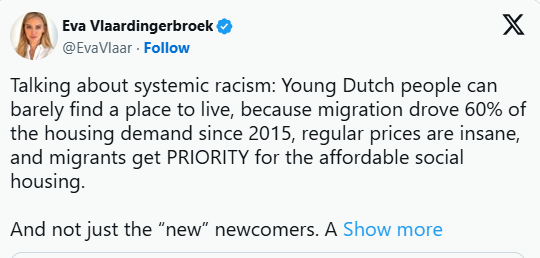
Talking about systemic racism: Young Dutch people can barely find a place to live, because migration drove 60% of the housing demand since 2015, regular prices are insane, and migrants get PRIORITY for the affordable social housing.
And not just the “new” newcomers. A 25-year-old Syrian who came here with his parents years ago jumps the queue for a home when he decides he wants to live on his own. Meaning a 25 year-old white Dutch guy can forget about getting his own place and ends up on waiting lists for 10+ years.
But according to our minister of housing that’s fine because they can just continue to “live with their parents.”
Putting the interests of foreigners above the interests of the native population, needs to end.
That’s why with the @SaveEuropeAct, apart from demanding closed borders and Remigration, we also demand Removing social welfare incentives and benefits that function as pull factors for migration.
— Eva Vlaardingerbroek (@EvaVlaar) October 13, 2026
United Kingdom. Asylum seekers waiting for decisions are housed by the government, often in hotels or private dispersal accommodation. Once granted refugee status they become eligible for social housing on a needs basis. In London, nearly half of social housing households are headed by someone born outside the UK. Nationally, new social lettings still go mostly to UK nationals, but the foreign-born share has risen and is higher among groups from Afghanistan, Eritrea, Iran, and Syria. Local waiting lists stretch for years in many areas. Politicians from Reform UK and the Conservatives have proposed restricting new social tenancies to British citizens or long-term residents and prioritizing veterans and local families. Opponents call it discriminatory. Councils already face pressure from hotel contracts and conversions of family homes into multi-occupancy units for asylum accommodation.
France. Immigrants are overrepresented in HLM social housing: about 30 percent of immigrants live in it, compared with roughly 11 percent of people without a migration background. Beneficiaries of international protection rank as a priority group under the housing code. The DALO law (enforceable right to housing) requires authorities to rehouse people in urgent need — including many living in temporary shelters or overcrowded conditions — ahead of ordinary applicants. A family that meets those urgent criteria can be placed before someone who has waited five years on a standard list. Allocation rates themselves are not dramatically higher for non-European households, but the combination of priority rules, larger average family sizes, and concentration in certain neighborhoods produces the overrepresentation. Polls show large majorities of French people want social housing reserved first for French nationals.
In the Netherlands, the Housing Minister, asked about why she builds homes for migrants when young Dutch couples can’t find houses, responds with: “starters can fortunately live with their parents”.
We have to stay with our parents and pay for houses for migrants that hate us, built by a regime that hates us. This cannot go on.
— Dries Van Langenhove (@DVanLangenhove) October 13, 2026
Germany. Recognized refugees receive the same access to social benefits and housing support as citizens. Many remain stuck in reception centers for months or years because private and social housing is scarce and expensive. Local authorities must place them somewhere. In one widely reported 2023 case in Lörrach, a city housing company notified about 40 tenants that their building would be cleared to house refugees, offering alternative units. Legal experts noted that ordinary tenancy law does not allow eviction simply to free space for newcomers, and the episode triggered strong local backlash. Overall, foreign nationals are heavily overrepresented among people in emergency shelters. Germany’s housing shortage is structural, and successive waves of asylum inflows have added lasting demand.
Labour would rather house illegal migrants than British soldiers.
Reform UK will prioritise veterans for social housing and invest in proper homes for our armed forces. https://t.co/0LluqF5hNL
— Reform UK (@reformparty_uk) October 17, 2026
Spain. Public debate has shifted toward “national priority.” In regional coalition deals, the conservative PP and the right-wing Vox party have agreed to favor people with long-term ties to the area when allocating public housing and certain benefits. Requirements of five or ten years of local registration effectively give Spaniards who have lived in the region longer an edge over recent arrivals. The national Socialist government calls the approach discriminatory and has opposed it. Supporters argue that Spanish citizens currently lose out on scarce public housing and aid. The argument tracks the same complaint heard in the other countries: when housing and welfare are tight, open-ended priority for newcomers crowds out the people who have paid into the system longest.
Across these countries the pattern is consistent. Asylum systems that grant status quickly create a right to housing support. Social housing and emergency accommodation are finite. Young natives and lower-income locals face multi-year waits or stay with parents. Construction has not kept pace with population growth driven by migration. Officials defend the priority on humanitarian grounds and legal obligations. Voters in several countries have responded by demanding tighter rules that put citizens and long-term residents first when the supply is short.
Also tracking on the feed: ongoing debates over election integrity and midterm maps, and the latest on health policy and vaccine mandates.
— The Whatfinger News Team: Sgt R and Luke, with Grok on edits
Top Features and Vids across Whatfinger
- “Mountains Of Evidence” Ilhan Omar IS COOKED, Obama Comes To her DEFENSE
- AOC Brutally Mocked For Latest Stunt As She’s In Full Blown Panic
- He just watched the ad and it was BRUTAL. James O’Keefe exposed Abdul
- Nobody on welfare should be voting. I said it – The stats on Cali will shock you. Fast clip
- This is the horrifying moment when Catholic priest was flattened by a crucifix during a service
- Bones, carved marks, and a drowned plain keep forcing the same question: how early did people start organizing, building, and recording things that look a lot like civilization?








CLICK HERE FOR COMMENTS