
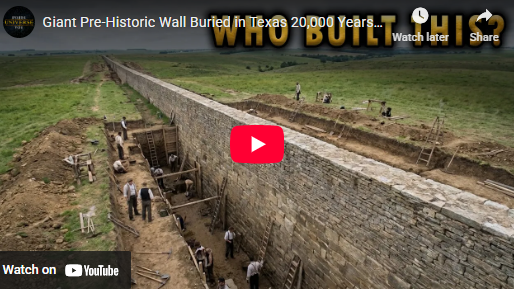

Beneath the quiet streets of Rockwall, Texas, lies a buried enigma that has defied explanation for over a century. This vast, orderly wall of stone, stretching beneath the earth, hints at a prehistoric city or ancient structures built by lost civilizations. Its presence fuels speculation, making it one of the world’s great unsolved mysteries in ancient history. (Their words and title. We of course had to look into it so read below the vid)
Since we love a great mystery at Whatfinger News, we had to research it all. Using ChatGPT, Google, Bing and Grok, the following is put together. Take it as you will….
Scientific and Geological Facts
The Rockwall formation has been known since the mid-19th century when settlers in what is now Rockwall County, Texas (named after the feature), uncovered wall-like rock structures while digging. It’s not a single continuous wall but a series of disconnected, underground sandstone features extending dozens of feet deep in places, trending in various directions across the area. Geologists have extensively studied it, and the consensus is that it’s a natural phenomenon known as sandstone dikes—vertical cracks in the earth filled with sediment that hardened over millions of years, creating the illusion of constructed walls.
Key facts from reliable sources:
- The U.S. Geological Survey (USGS) and Smithsonian Institution examined samples in the early 20th century and concluded it’s natural, formed by sedimentary processes in ancient rock layers.
- A 1979 study by geologist Kenneth Schaar analyzed exposed sections and confirmed them as sandstone dikes, though he noted some ambiguity in unexamined areas.
- Paleomagnetic dating in later studies showed the rocks formed naturally around 33-40 million years ago, far predating human presence, with no evidence of tool marks, mortar, or human artifacts beyond occasional misinterpretations (e.g., iron concretions mistaken for metal disks).
- Excavations, such as those in 2012 at Stodghill Farm and ongoing ones near FM 549 and Cornelius Road under Rockwall County oversight, have revealed no definitive signs of human engineering, like consistent mortar or cut stones.
Debunking common claims:
- The “perfect alignments” and “arches” are often cherry-picked; full mappings show irregular, non-enclosing patterns inconsistent with a deliberate wall.
- Reports of a “giant’s skull” from 1886 or embedded “serpent heads” have been dismissed as folklore, fossils, or hoaxes, with no verified artifacts in museums.
- The formation’s burial under sediment is explained by natural erosion and deposition over geological time, not a catastrophic event hiding an ancient city.
Alternative Theories and Discussions
On platforms like X (formerly Twitter) and Reddit, the topic attracts speculation, often tying it to ancient astronaut theories, giants, or pre-Ice Age civilizations. For instance:
- Some users share the video directly, claiming it’s evidence of suppressed history.
- Others compare it to global megaliths (e.g., in Peru or Malta) and argue for advanced prehistoric engineering, suggesting ground-penetrating radar (GPR) scans show intentional geometry.
- Proponents like architect John Lindsey (1996) and archaeologist Byron de Prorok (1925) have argued for man-made origins based on visual inspections, though these lack modern scientific rigor.
- Broader conspiracy narratives link it to a “lost civilization” wiped out around 12,000 years ago (end of the Younger Dryas period), similar to theories about Göbekli Tepe or other North American anomalies.
However, these views are largely from non-expert sources and haven’t held up to peer-reviewed scrutiny. Excavations are limited due to private land ownership and urban development, not a cover-up, though this fuels speculation.
Possibility of an Actual Ancient Wall?
While intriguing, the likelihood of this being a wall built by an ancient civilization is low based on current evidence. Human presence in North America dates back at least 20,000-23,000 years (e.g., footprints in New Mexico or tools in Texas), but there’s no archaeological record of large-scale stone architecture from that era—early inhabitants were nomadic hunter-gatherers without the tools or organization for such feats. The formation’s age (millions of years) and composition align with natural geology, not human work. That said, if future digs uncover unambiguous artifacts (e.g., tools or inscriptions), it could reopen the debate—similar to how Göbekli Tepe challenged timelines. For now, it’s best viewed as a fascinating natural oddity that inspires myths, much like other “mystery walls” worldwide.

CK Sheldon (Sgt K) and Beth at Whatfinger News












CLICK HERE FOR COMMENTS