


The End of Anonymous Encounters: How AI-Powered Glasses Let Anyone Dox You on the Spot. Article is under this top clip showing the tech 🛑
RIP Privacy — AI Glasses Can Now Recognize Anyone, Anywhere.
A Dutch journalist just tested a pair of AI-powered glasses that can instantly identify strangers on the street.
No government database. No police system. Just public data and off-the-shelf AI.
You look at someone… pic.twitter.com/AUPu2AoekE
— Pascal Bornet (@pascal_bornet) December 6, 2025
A Dutch journalist just tested a pair of AI-powered glasses that can instantly identify strangers on the street. No government database. No police system. Just public data and off-the-shelf AI. You look at someone and in seconds, their name, LinkedIn, and background appear before your eyes. The scariest part? You can’t really stop it. You can ban it, regulate it, add blinking red lights… but once tech like this exists, someone will always find a way to use it. To me, this marks a turning point. We’ve officially blurred the line between seeing people and knowing them. Between being in public and being exposed. So here’s the question: When every face becomes a dataset, how do we protect the meaning of being human?
In a chilling video that’s racked up millions of views, a Dutch journalist walks the streets wearing unassuming smart glasses. As he glances at passersby, their names, LinkedIn profiles, social media accounts, and personal backgrounds pop up in real-time overlays. No consent, no warning—just instant exposure. Shared by AI expert Pascal Bornet on X in December 2025, the clip declares: “RIP Privacy — AI Glasses Can Now Recognize Anyone, Anywhere.” Bornet warns that this isn’t sci-fi; it’s built on off-the-shelf tech, public data, and AI, turning every public interaction into a potential data harvest. This isn’t isolated. In 2024-2025, hackers, students, and startups have repeatedly demonstrated how easy it is to bolt facial recognition onto consumer smart glasses.
The core tech relies on a simple pipeline: A camera in the glasses captures faces discreetly, streams the feed to a phone or computer, uses AI to detect and crop faces, uploads to reverse image search engines like PimEyes or FaceCheck.ID, matches to online photos, then scrapes public records (voter rolls, social media, people-search sites) with large language models (LLMs) like GPT-4 to compile dossiers—names, addresses, relatives, jobs, even SSNs in some cases. Results appear in seconds, overlaid via AR display or phone app. The breakthrough enabler? Meta’s Ray-Ban Meta Smart Glasses ($299+). These stylish frames (co-designed with Ray-Ban) have a hidden 12MP camera, open-ear speakers, and live-streaming to Instagram/Facebook.
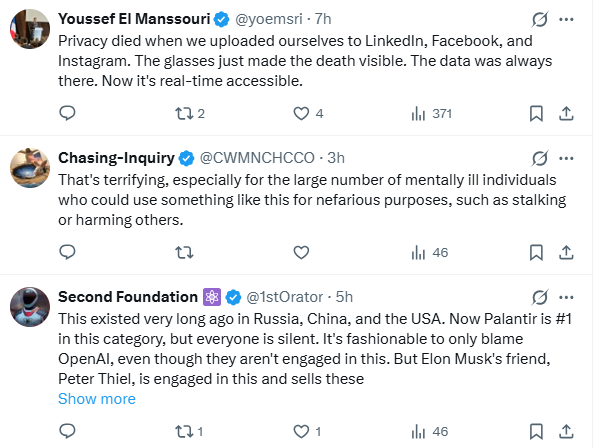
That AI only works because we spent 15 years feeding public databases with our real names, faces, and habits in exchange for ‘free’ apps. The only defense left is data minimization. We can’t ban the glasses. But we can start starving the beast. – Inomy
Harvard dropouts AnhPhu Nguyen and Caine Ardayfio created I-XRAY in 2024: Stream video from the glasses, AI detects faces, queries PimEyes (a facial search engine indexing billions of web photos), cross-references with data brokers, and feeds back info. In demos, they doxxed strangers on the street, approaching them as “old friends” with harvested details. They didn’t release the code, calling it a privacy wake-up call. Similar hacks followed. South Bend entrepreneurs built apps linking Ray-Ban Metas to ChatGPT for instant insights. Meta itself is pushing boundaries: Reports from 2025 reveal prototypes codenamed Aperol and Bellini with “super-sensing” live AI, including opt-in facial recognition to identify people and remind wearers of contexts (e.g., “That’s Bob from last year’s conference”). Privacy lights signal recording, but bystanders have no say. Other products amplify the threat:
- Brilliant Labs’ Frame AI Glasses ($349): Open-source AR with camera, microphone, and multimodal AI—no built-in recognition, but hackable like I-XRAY.
- Even Realities G1/G2: Privacy-focused (no camera/speakers), HUD display for text/AI, but avoid the doxxing risk entirely.
- Assistive tech like Envision Glasses or OrCam MyEye: On-device recognition for known faces (visually impaired users), but not public doxxing.
- Enterprise: Vuzix or Ipsotek’s VILens for security, overlaying IDs on guards’ vision.
Anyone can replicate this today. Buy Ray-Ban Meta glasses, subscribe to PimEyes (~$30/month), use free tools like Python scripts for face detection (OpenCV), and LLMs to aggregate data. No elite hacking needed—two students did it as a side project. In public? Legal gray area in most places; no U.S. federal ban on private facial recognition. The implications are dystopian. Social engineering becomes trivial: Stalkers, scammers, or creeps gain instant leverage. Dating? Job interviews? Casual chats? One glance reveals everything you’ve ever posted. Bornet asks: “When every face becomes a dataset, how do we protect the meaning of being human? “Defenses are slim: Opt out of data brokers (FastPeopleSearch, etc.), blur faces online, or wear anti-facial-recognition makeup/patterns. But as Bornet notes, “You can ban it… but someone will always find a way.” Meta’s pushing forward, emboldened by lighter regulation. Privacy isn’t dead—it’s on life support. This tech marks the death of anonymity in public. We’re not ready.
Research Links
- “Someone Put Facial Recognition Tech onto Meta’s Smart Glasses to Instantly Dox Strangers” – 404 Media
https://www.404media.co/someone-put-facial-recognition-tech-onto-metas-smart-glasses-to-instantly-dox-strangers/ - “Meta’s Ray-Ban Smart Glasses Used To Instantly Dox Strangers In Public, Thanks To AI And Facial Recognition” – Forbes
https://www.forbes.com/sites/johnkoetsier/2024/10/03/metas-ray-ban-smart-glasses-used-to-instantly-dox-strangers-in-public-thanks-to-ai-and-facial-recognition/ - “Harvard students turned smart glasses into facial recognition devices” – WBUR Here & Now
https://www.wbur.org/hereandnow/2025/01/30/glasses-facial-recognition - “Meta forges ahead with facial recognition for its AI glasses” – Mashable
https://mashable.com/article/meta-facial-recognition-ai-glasses-privacy-concerns - “Two Harvard Students use Meta Ray-Bans and AI To Get Personal Information” – Forbes
https://www.forbes.com/sites/lindseychoo/2024/10/04/meta-ray-bans-ai-privacy-surveillance/ - “College students used Meta’s smart glasses to dox people in real time” – The Verge
https://www.theverge.com/2024/10/2/24260262/ray-ban-meta-smart-glasses-doxxing-privacy - “Facial recognition glasses turn everyday life into creepy privacy nightmare” – Fox News
https://www.foxnews.com/tech/facial-recognition-glasses-turn-everyday-life-creepy-privacy-nightmare
Mal Antoni and Sgt Pat at Whatfinger News













CLICK HERE FOR COMMENTS