The Emerging Axis – Russia’s $25 Billion Nuclear Deal with Iran Bolsters Ties with China, Rendering the West Impotent – Whatfinger News' Choice Clips
Whatfinger News' Choice Clips

The Emerging Axis – Russia’s $25 Billion Nuclear Deal with Iran Bolsters Ties with China, Rendering the West Impotent

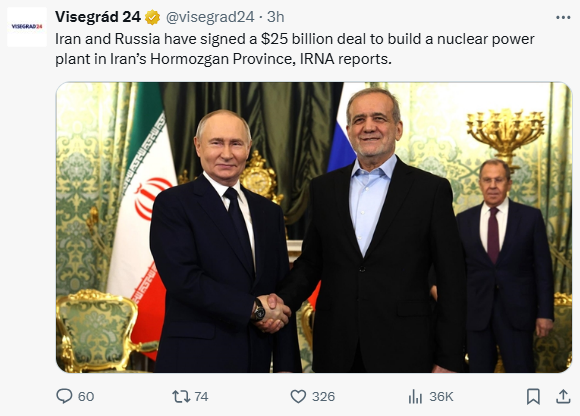
In a move that underscores the accelerating geopolitical realignment, Iran and Russia have inked a staggering $25 billion agreement to construct four advanced nuclear power plants in southern Iran’s Hormozgan province. Announced by Iranian state media on September 26, 2025, the deal involves Russia’s state-owned Rosatom corporation building third-generation reactors in the coastal city of Sirik, near the strategically vital Strait of Hormuz. This pact not only enhances Iran’s energy independence amid crippling Western sanctions but also cements Moscow’s role as Tehran’s indispensable partner in defying U.S.-led isolation efforts.
Far from an isolated transaction, this nuclear collaboration is a cornerstone of a burgeoning “new Axis” comprising Russia, Iran, and China—an unholy trinity of autocratic powers increasingly coordinated in their challenge to Western dominance. As the United States and its allies grapple with internal divisions, economic strains, and military overextension, this axis is forging ahead, exploiting multipolarity to reshape global order in ways the West appears powerless to halt.The Russia-Iran nuclear deal arrives at a pivotal moment, building on years of deepening bilateral ties forged in the fires of mutual adversity. Since Russia’s full-scale invasion of Ukraine in 2022, Iran has supplied thousands of Shahed drones and ballistic missiles to Moscow, bolstering its war machine in exchange for advanced military technology, including Su-35 fighter jets and S-400 air defense systems.
The $25 billion pact, signed during high-level talks in Tehran, extends this partnership into the civilian nuclear realm, where Rosatom will oversee construction and potentially aid in deploying small modular reactors across Iran. Iranian officials hailed it as a “long-term strategic cooperation” that circumvents Western restrictions, while Russian Energy Minister Nikolai Shulginov emphasized its role in “strengthening energy security” for both nations. Critically, this deal flouts U.S. concerns over Iran’s nuclear ambitions, with the plants’ location near the Strait of Hormuz—a chokepoint for global oil flows—adding a layer of strategic leverage that could disrupt international shipping in any escalation. Yet, this bilateral bonhomie is merely one facet of a larger mosaic: the solidification of a Russia-China-Iran axis that analysts dub the “Axis of Upheaval” or “CRINK” (China, Russia, Iran, North Korea).
Russia’s pivot eastward, accelerated by Western sanctions post-Ukraine, has intertwined its fate with China’s “no-limits” partnership, declared in 2022 and evolving toward a de facto mutual defense pact. In May 2025, Presidents Vladimir Putin and Xi Jinping signed a joint declaration on global strategic stability, committing to enhanced military interoperability through joint exercises, technology sharing, and coordinated diplomacy. This “unstoppable axis,” as described in conservative analyses, leverages Russia’s vast natural resources—oil, gas, and rare earth minerals—with China’s manufacturing prowess and population of over 1.4 billion, creating a Eurasian behemoth capable of outlasting the West in protracted conflicts.

Iran’s integration into this bloc is seamless and symbiotic. Tehran joined the Shanghai Cooperation Organization (SCO) in 2023, a China-Russia-led forum that has morphed from a regional security pact into a counterweight to NATO. By September 2025, SCO summits in Beijing featured leaders from China, Russia, Iran, and North Korea, signaling an “anti-American axis” through shared grievances against U.S. hegemony. Economically, China has become Iran’s largest trading partner, importing discounted oil in defiance of sanctions and investing in infrastructure via the Belt and Road Initiative. Militarily, the trio coordinates proxy actions: Iran’s Houthi allies disrupt Red Sea shipping, Russia’s Wagner remnants (now Africa Corps) secure African resources, and China’s navy expands in the Indo-Pacific, stretching U.S. forces thin.

North Korea’s inclusion adds nuclear saber-rattling and missile tech, further complicating Western responses. This axis thrives on the West’s vulnerabilities, rendering traditional levers of power—sanctions, alliances, and military deterrence—ineffective. U.S.-led sanctions have backfired spectacularly; Russia’s economy grew 3.6% in 2024 despite isolation, thanks to trade rerouted through China and Iran. The nuclear deal exemplifies this: Rosatom, already sanctioned, proceeds undeterred, as the axis creates parallel financial systems like dedollarized trade and BRICS’ alternative payment mechanisms. China’s dominance in global supply chains—producing 80% of solar panels and controlling critical minerals—gives it veto power over Western green transitions, while Russia’s energy exports fuel allies’ economies.

Militarily, the West’s impotence is glaring. NATO’s Article 5 is unmatched, but the axis avoids direct confrontation, opting for hybrid warfare and multi-theater distractions. A potential Russia-China pact would enforce mutual assured destruction (MAD), confining conflicts to conventional realms where the duo’s combined defense budget ($393 billion) and manpower advantages overwhelm. Simulations like the “War of 2026” foresee U.S. exhaustion from simultaneous fronts: a Chinese Taiwan invasion, Russian European incursions, and Iranian Gulf disruptions. U.S. recruitment shortfalls, aging fleets, and ally fatigue—Europe’s energy dependence on Russia persists despite rhetoric—exacerbate this.

Iran’s muted pleas for aid during its 2025 clashes with Israel highlighted the axis’s limits, but China’s diplomatic cover and Russia’s arms sustained Tehran. Diplomatically, the West’s moral high ground erodes as multipolarity empowers the Global South. BRICS expansion in 2024-2025, including Iran and Saudi Arabia, challenges IMF dominance, with over 40 nations queuing to join. The axis frames itself as anti-imperialist, appealing to developing nations weary of U.S. interventions. Internal Western discord—U.S. political polarization, Europe’s migration crises, and transatlantic rifts over trade—further paralyzes response. Trump’s isolationist leanings and Biden-era overcommitments have alienated allies, while China’s “win-win” diplomacy wins hearts in Africa and Latin America. The implications are dire: a world where the axis dictates terms on energy, technology, and security. Taiwan remains a flashpoint, with China’s navy—the world’s largest by hull count—poised for action, potentially crippling global semiconductors.
In the Middle East, Iran’s nuclear threshold, aided by Russian tech, could spark proliferation. For the U.S., this spells economic collapse from disrupted trade and inflated defense spending, eroding its superpower status. As one analyst warns, “It would be wise to STOP POKING THE BEAR,” lest provocation accelerates this doom. To sumi it all up: Russia’s nuclear pact with Iran is the latest brick in an axis wall that China helps mortar, creating a fortress against Western influence. With sanctions toothless, alliances fracturing, and multipolarity ascendant, the West watches helplessly as this new order dawns. Unless it recalibrates—perhaps through pragmatic diplomacy or bolstering domestic resilience—the axis’s rise may indeed spell doom for the liberal world order.

Links

Ben and Sgt K at Whatfinger News. 


Comey Indicted! Trump’s Reckoning: Pursuing Justice Against the Architects of the 2020 Election Steal and the Russia Hoax 🛑


For HOURS of fun – Steve Inman as well as other humor, quick smile clips , more – Whatfinger’s collection


CLICK HERE FOR COMMENTS

Two End Up In Handcuffs After Punches & Purses Start Flying Inside A Mall’s Indoor Family Entertainment Center – Outkick

Brits told to ‘wear a mask’ as flu spreads across country – Express (It doesn’t matter that masks are 100% NOT effective for Flu or even Covid viruses, what matters is the dictates, forcing Brits to wear masks, which means even harsher BS is coming right now) 

Russian couple ‘watched each other being tortured to death’ over £380,000,000 in crypto – Metro

U.S. Businesses Are Going Bankrupt At An Absolutely Blistering Pace – Economic Collapse

Pakistani Muslim Terrorist Busted Planning to Shoot Up University of Delaware – Frontpage Mag

Pay 0% interest until 2027 and tell Visa to kiss your balanced backside. Because nothing says freedom like watching minimum payments shrink faster than CNN’s ratings. → Sponsored 


‘The Five’: Talk about a MELTDOWN… – Fox


HORROR: Monster with Dozens of Prior Arrests Punches Elderly Man, Shoves Him onto Train Tracks in Chicago Gateway Pundit

The spectacle of Bryan Johnson and his livestreamed shrooms trip – TechCrunch

Stefanik Says Speaker Johnson is Protecting the DEEP STATE — Claims He’s Blocking Provision to Root Out the Illegal Weaponization Behind Crossfire Hurricane and Arctic Frost — Siding With Raskin Against Trump Republicans Gateway Pundit

8-Year-Old Boy Arrested After Pulling Gun on Teacher – Bearing Arms

1 in 5 Harvard Grads Claim to be ‘Disabled’ “Already, at one law school, 45 percent of students receive academic accommodations.” – Frontpage Mag

OpenAI CEO declares “code red” as Gemini gains 200 million users in 3 months – Ars Technica

Orca goes on beach to get a seal snack, throws it around like a rag doll – Fast clip – Rumble 😲

Air breathing fish that can survive on land for days. Holy cow… Imagine if they were Piranha – lol Rumble

Are they this stupid, or just willfully ignorant? Leftists need mental help – Fast clipRumble 😡

Chinese Tool California Rep Eric Swalwell is not a resident of California – Fast clipRumble

Ever hear of a pyrosome? It’s a huge creature made up of thousands of tiny ones – I never saw this before – Rumble

Latest Posts

Watch MAGA made this Whatfinger commercial, pretty cool huh!