

-MIT ran the first brain-scan study on ChatGPT users over 4 months -83.3% of users couldn’t recall a single sentence written minutes earlier -Brain connectivity dropped by 47%, from 79 to 42 points -Even after stopping AI use, users stayed under-engaged -Essays were solid but described as robotic and soulless -ChatGPT made people 60% faster but reduced mental effort by 32% -Top group started without AI, then added it later -They showed the best memory, brain activity, and scores -Heavy AI use may dull thinking over time -Using AI can offload your brain—fast results, low learning Key takeaway: Don’t avoid AI, but use it wisely -Let AI assist your thinking, not replace it -Build skills with it, not dependency -Raises big questions about when and how kids should use LLMs -Early overuse could weaken long-term cognitive development -This MIT study shows the way we use AI matters more than ever.
We posted this clip yesterday… This makes sense so don’t be lazy. Neuroscientist Dr. Farhan Khawaja: Your increasing reliance on AI is damaging your brain. “And I’m going to give you three examples how.”
This makes sense so don’t be lazy.
Neuroscientist Dr. Farhan Khawaja: Your increasing reliance on AI is damaging your brain.
“And I’m going to give you three examples how.” pic.twitter.com/4iL5hbJlVw
— Disprin (@DisprinXtra) July 25, 2025
🧠 THIS AI HABIT IS MAKING YOU DUMBER
MIT scanned students’ brains while they used ChatGPT.
What they found?
Wild.
🧠 42 neural connections with AI
🧠 79 without it
That’s almost double when you think for yourself.
Even worse…
🧠 83% of AI users couldn’t recall what they… pic.twitter.com/4yU4VAz3p6— Julian Goldie (@aiseomastery) July 24, 2025
Specifics from the Study
Study Methods: The research involved 54 participants (aged 18-39, mostly from the Boston area) divided into three groups:
- LLM group: Used ChatGPT (specifically GPT-4o) to assist with writing.
- Search Engine group: Used Google Search (with AI-generated answers prohibited).
- Brain-only group: Relied solely on their own knowledge and thinking, without tools.
Participants wrote SAT-style essays on assigned topics within 20-minute sessions, repeated over four months (three initial sessions maintaining group assignments, and a fourth session with 18 participants switching: LLM users switched to no tools, and Brain-only switched to LLM). Data was collected via:
- EEG (electroencephalography): Measured brain activity and connectivity across 32 electrodes, focusing on frequency bands like theta (4-8 Hz, linked to memory and creativity), alpha (8-12 Hz, attention and relaxation), beta (12-30 Hz, active thinking), delta (0.1-4 Hz, deep processing), and gamma (30-100 Hz, high-level integration). This was processed using dynamic Directed Transfer Function (dDTF) analysis to map neural networks.
- Behavioral assessments: Post-session interviews on essay “ownership” (how much participants felt the work was theirs), ability to quote sentences from their essays minutes later, and memory recall.
- Linguistic analysis: Natural language processing (NLP) to evaluate essay originality, word variability, named entity recognition (NER), n-grams (phrase patterns), and ontology (topic structure).
- Scoring: Essays graded by human English teachers and an AI judge for quality, uniqueness, and content.
The study emphasized educational contexts, warning about potential long-term effects on developing brains, such as in schools.Key Findings
- Neural Connectivity: The Brain-only group showed the strongest and most widespread brain networks across all frequency bands, indicating higher cognitive load, creativity, and semantic processing. The Search Engine group had intermediate engagement (34-48% lower than Brain-only), while the LLM group exhibited the weakest coupling (up to 55% reduced), suggesting less self-driven thinking and more automation. For example, in theta and high-alpha bands, Brain-only participants had significantly higher activity.
- Memory and Recall: 83.3% of LLM users couldn’t quote a single sentence from their essays minutes after writing in early sessions, compared to much better performance in other groups. Even after switching to no tools in session 4, former LLM users showed persistent under-engagement and poor recall (7/9 failed quoting), while Brain-only users adapted well to LLM use.
- Essay Quality and Perception: LLM-assisted essays were homogeneous, with biases toward generic phrases (e.g., career-focused n-grams), lower word length variability, and described as “robotic and soulless” by teachers—lacking personal insights despite solid structure. Brain-only essays scored higher for uniqueness and insight.
- Behavioral Outcomes: LLM users reported low ownership of their work and underperformed linguistically and behaviorally. Over time, they relied more on copy-paste, with brain activity decreasing, while Brain-only users showed increasing engagement
- Overall Impact: ChatGPT made tasks 60% faster but reduced mental effort by about 32%, with a 47% drop in neural connectivity scores (from ~79 to ~42 points in some metrics). The study posits that heavy AI use may dull thinking long-term, even after stopping.
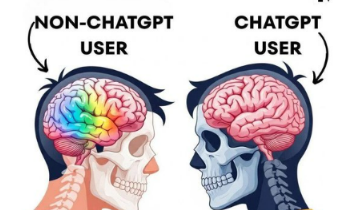
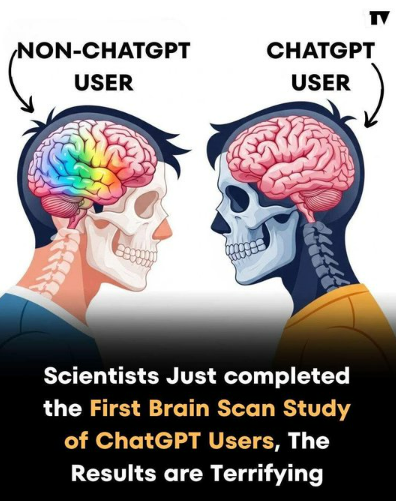
These align closely with the claims in the X post, though the post’s image appears to be an illustrative or sensationalized graphic (likely not from the actual study, as it used EEG data rather than colorful fMRI-style scans).Balanced PerspectiveWhile the findings are concerning, they are preliminary due to the small sample size (especially in session 4) and lack of peer review. Some experts argue the results may reflect study design artifacts, like familiarization effects benefiting the Brain-only group over multiple sessions, rather than inherent AI harms. AI could enhance learning if used for advanced tasks (e.g., generating plans for critique) instead of replacing basics, similar to how calculators shifted math education without “rotting” brains. The key is balanced use: AI as a tool to augment, not replace, thinking.
- Full pre-print paper (PDF): https://arxiv.org/pdf/2506.08872.pdf
- MIT Media Lab project page: https://www.media.mit.edu/projects/your-brain-on-chatgpt/overview/
- TIME magazine summary: https://time.com/7295195/ai-chatgpt-google-learning-school/
- The Conversation article (for nuance): https://theconversation.com/mit-researchers-say-using-chatgpt-can-rot-your-brain-the-truth-is-a-little-more-complicated-259450
From the People
- You are being reprogrammed: MIT study found that heavy AI use, like ChatGPT, reduces memory, critical thinking, and brain activity, based on EEG scans of 54 students over four months. Frequent AI users produced less original work, struggled to recall their writing, and exhibited “mental passivity,” even when switching to unaided tasks. The study suggests AI can create echo chambers and is best used as a support, not a substitute, for human thinking. – Eric M
- True, research on EEG brainscans show those who rely on ChatGPT and AI tools have lowest brain engagement in neural, linguistic and behavioural, and could destroy memory, critical thinking and brain activities.
- Is AI Making Our TTRPGs Worse? I just read an article and saw some fascinating research that confirms a fear I’ve had: using AI for creative work can be fundamentally bad for our hobbies and our brains. The research points to a scary concept called “cognitive debt.” Essentially, the more we outsource our thinking to AI, the less capable our minds become at creative tasks. For TTRPGs, this translates into the wave of cheap, predictable, and soulless content we’ve seen flooding marketplaces. These AI-generated scenarios often lack the unique twists, emotional depth, and memorable quirks that a human Game Master crafts. While AI can be a handy assistant for editing or breaking writer’s block, we’re seeing what happens when it’s used as a crutch. It trades the magic of human ingenuity for bland, repetitive content. Our hobby is built on imagination, collaboration, and the beautiful unpredictability of the human mind. Let’s not trade that for a soulless algorithm. What are your thoughts on using AI in your games? Have you found a good balance, or are you avoiding it entirely? Draser
Using AI Makes Your Brain Lazy, Even After You Stop Using It, New Study Shows
- Is Ivermectin the Key to Fighting Cancer? People are being cured all over the world…. – Wellness (Dr. McCullough’s company) Sponsored Post 🛑 You can get MEBENDAZOLE and Ivermectin from Wellness 👍
- Be prepared for anything, including lockdowns with your own Emergency Med kit – see Wellness Emergency Kit (includes Ivermectin and other essential drugs, guide book, much more… peace of mind for you and your family) 🛑 – Dr. McCullough’s company! – Sponsor
- How can you move your 401K to Gold penalty free? Get the answer and more with Goldco’s exclusive Gold IRA Beginner’s Guide. Click here now! – Goldco
- The Truth About Weight Loss After 40 – Wellness Can Help You – Sponsor
- Facebook doesn’t want you reading most sites we link to or any vids we post. Their algorithm hides our pages and humor too as best it can. The way to stick it to Zuckerberg? Sign up for our once-a-day newsletter. Takes 6 seconds. We send out the best – most popular links daily, no spam, plus a splash of honesty even beyond Whatfinger’s homepage…. – CLICK HERE










CLICK HERE FOR COMMENTS