
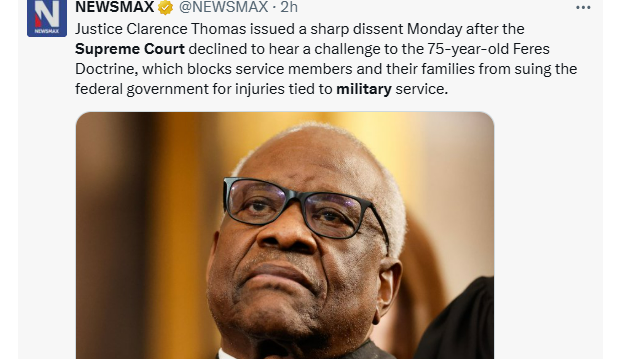

In a heart-wrenching ruling that has ignited fury across military communities, the U.S. Supreme Court on November 24, 2025, declined to hear the wrongful death lawsuit filed by Kari Beck, the widow of Air Force Staff Sergeant Cameron Beck. The 7-2 decision upheld the infamous Feres doctrine—a 75-year-old judicial barrier that shields the federal government from accountability for negligence causing the deaths or injuries of active-duty servicemembers. Justice Clarence Thomas, in a blistering eight-page dissent joined only by Justice Samuel Alito, lambasted the majority for dodging a chance to dismantle this “indefensible” precedent, arguing it perpetuates “deeply unfair results” that betray the very heroes it claims to honor.
As military families reel from yet another courtroom door slammed shut, the ruling underscores a profound disconnect: while civilians can sue the government for everyday negligence, those who volunteer to defend the nation are left to grieve without recourse, their losses dismissed as mere “incidents of service.”The tragedy at the heart of Beck v. United States unfolded on a routine Missouri afternoon in 2021. Staff Sgt. Beck, a devoted husband and father to a seven-year-old son, was riding his motorcycle off-duty from Whiteman Air Force Base to meet his family for lunch. In a split second, a civilian federal employee—driving a government van while distracted by her cell phone—turned left into his path, killing him instantly. The driver later pleaded guilty, admitting the crash was “100 percent” her fault.
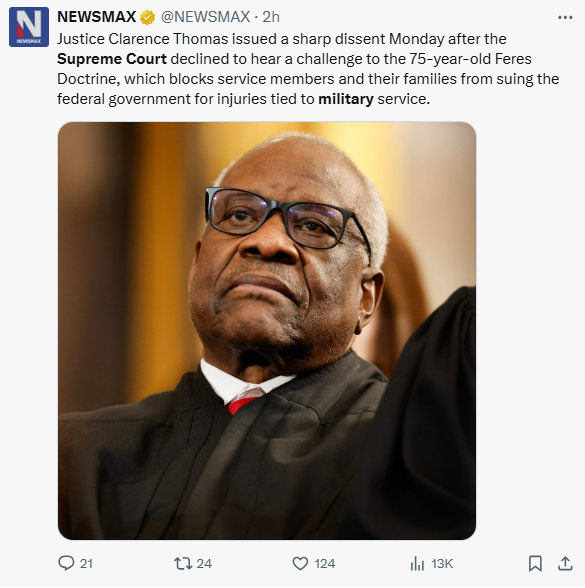
Under any normal circumstance, this would be an “open-and-shut” wrongful death case, potentially worth millions in damages for Beck’s grieving widow and child. Yet, lower courts dismissed Kari Beck’s suit outright, citing the Feres doctrine from the 1950 Supreme Court case Feres v. United States. That ruling barred servicemembers from suing under the Federal Tort Claims Act (FTCA) for harms “incident to service,” reasoning that military discipline and veterans’ benefits should suffice as remedies. The Eighth Circuit Court of Appeals affirmed, stretching Feres to ensnare even off-base, personal errands like Beck’s lunch run.Thomas’s dissent cuts like a knife through the legal fog, exposing Feres as a textual and policy abomination. “Feres is indefensible as a matter of law, and senseless as a matter of policy,” he wrote, echoing his prior calls to torch the doctrine entirely. He argued the FTCA—Congress’s 1946 waiver of sovereign immunity for tort claims—contains no carve-out for military personnel; Feres invented one, ignoring the statute’s plain text. Even if Feres stood, Thomas contended, Beck’s death didn’t qualify: “Staff Sergeant Beck was not ordered on a military mission to go home for lunch with his family. So Mrs. Beck should have prevailed under Feres.”
He slammed the lower courts’ “vague rationales” for expanding the doctrine beyond its already bloated bounds, creating a catch-all shield for government bungling. Joined by Alito, Thomas urged the Court to grant certiorari, either to overrule Feres outright or enforce its limits faithfully. “If the Court does not want to overrule its precedents in this area, it should at least be willing to enforce them,” he thundered, decrying the majority’s refusal as judicial cowardice that leaves families “without redress for serious harms.”Even in concurrence with the denial, liberal Justice Sonia Sotomayor couldn’t hide her discomfort, writing separately to spotlight Feres’s “deeply unfair results.” She called on Congress to intervene, a nod to bipartisan reform efforts like the stalled Feres Repeal Act. But for military families, such platitudes ring hollow.
The backlash has been swift and searing, with Gold Star spouses and veterans’ advocates branding the decision a “betrayal” of those who serve. “This isn’t justice; it’s abandonment,” fumed one military widow on social media, echoing sentiments from groups like the National Military Family Association. Critics, including former Justice Antonin Scalia in a 1987 dissent, have long pilloried Feres for its “widespread, almost universal” condemnation—depriving families of accountability in cases from botched surgeries to toxic exposures, like the Camp Lejeune leukemia deaths. Military.com reported outrage from affected families, who argue the doctrine forces reliance on patchwork veterans’ benefits that pale against civil awards, exacerbating financial ruin amid grief. “Our warriors deserve better than a government that hides behind a 1950s relic,” said one veteran’s spouse in a viral post, highlighting how Feres fosters a culture of impunity, from distracted federal drivers to negligent medics.Thomas’s solo crusade—now a pattern in Feres challenges—amplifies the frustration.
In February 2025, he penned a 14-page dissent in a paralyzed Air National Guardsman’s malpractice suit, calling the doctrine “senseless” and urging its burial. Families aren’t just unhappy; they’re mobilized, pushing for legislative fixes amid a Court that, per Thomas, fiddles while justice burns. As Beck’s son grows up fatherless, the ruling isn’t mere legalese—it’s a stark reminder that for those in uniform, the ultimate sacrifice includes surrendering the right to hold power accountable. Until Congress or the Court acts, military kin will continue fighting shadows, their pleas drowned by precedent’s cold echo.
Research Links
- Thomas disagrees as Supreme Court rejects widow’s military death case
- Justice Thomas rebukes SCOTUS for denying widow’s case, says it lets government dodge blame
- Justice Thomas Dissents as Supreme Court Rejects Widow’s Wrongful Death Claim
- Clarence Thomas takes aim at Supreme Court doctrine issued decades ago
- Justice Thomas rails against ‘vague rationales’ in denying military widow right to sue US
- Justice Thomas Urges Revisiting Military Immunity
- Justice Thomas Urges Revisiting Military Immunity
- ‘Indefensible’: Justice Thomas Slams Feres Doctrine After Supreme Court Decides Not to Hear Military Case
- Widow of airman killed in on-base crash asks high court for review in Feres doctrine fight
- 1 Cite as: 604 U. S. ____ (2025) THOMAS, J., dissenting
- Supreme Court refuses, yet again, to review whether military members can sue for malpractice
- Supreme Court Rejects Opportunity to Overrule Feres Doctrine
- Over Thomas dissent, high court rejects West Point case
- Justice Thomas lambasts writ denial of paralyzed Air National Guard member’s tort claims
- Feres v. United States
Sgt Pat and Lisa at Whatfinger News
For HOURS of fun – Steve Inman as well as other humor, quick smile clips , more – Whatfinger’s collection
Whatfinger – The Wellness Company – Get 10% discount on all products – CLICK HERE

- Is Ivermectin the Key to Fighting Cancer? …. – Wellness (Dr. McCullough’s company) Sponsored Post 🛑 You can get MEBENDAZOLE and Ivermectin from Wellness 👍
- Did you take the Vax, or any boosters? Well… you can get help. Please get your heart checked ASAP – CLICK HERE for Wellness’ proven Ultimate Spike Detox – for anyone over 50 and DEFINITELY for those who took the vax – Wellness
- Be prepared for anything, including lockdowns with your own Emergency Med kit – see Wellness Emergency Kit (includes Ivermectin and other essential drugs, guide book, much more… peace of mind for you and your family) 🛑 – Dr. McCullough’s company! – Sponsor
- How can you move your 401K to Gold penalty free? Get the answer and more with Goldco’s exclusive Gold IRA Beginner’s Guide. Click here now! – Goldco
- Facebook doesn’t want you reading most sites we link to or any vids or features that we post. Their algorithm hides our pages and humor too as best it can. The way to stick it to Zuckerberg? Sign up for our 3x a week newsletter. Takes 6 seconds. We send out the best – most popular links daily, no spam, plus a splash of honesty even beyond Whatfinger’s homepage…. – CLICK HERE
- Tackle Your Credit Card Debt by Paying 0% Interest Until 2027 – Sponsored
- Whatfingers Health Vids to help you live longer. DO NOT let Big Pharma and any Doctor kill you slowly because that is what their higher-ups want for $. Remember: Bad doctors live by this: ‘Every patient cured is a patient lost’ – get it? The establishment, like RFK Jr says, wants to keep you sick and getting sicker for maximum profit. FIGHT – get the knowledge – CLICK HERE












CLICK HERE FOR COMMENTS