
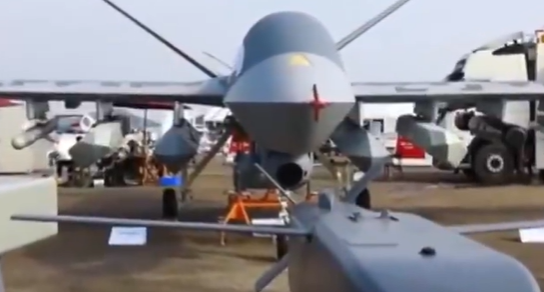

China unveils ‘world’s first’ autonomous drone that can hunt submarines: Report | Christopher McFadden, Interesting Engineering
The Wing Loong X debuts as China’s first long-endurance UAV designed for independent ASW missions.
China has officially unveiled its latest large… pic.twitter.com/7JZslXfeiE
— Owen Gregorian (@OwenGregorian) November 23, 2025
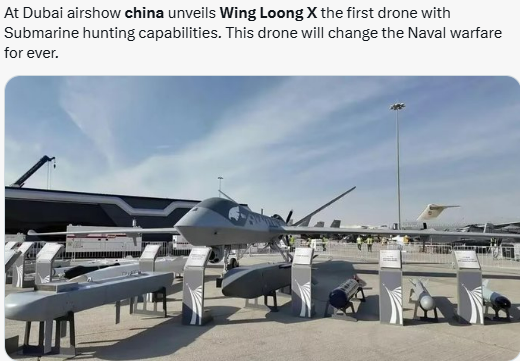
In the high-stakes theater of modern naval warfare, where stealthy submarines lurk as silent assassins beneath the waves, China has unveiled a game-changer: the Wing Loong X, a colossal autonomous drone billed as the world’s first capable of independently hunting and potentially destroying enemy subs. Debuted at the Dubai Airshow 2025 by the state-owned Aviation Industry Corporation of China (AVIC), this behemoth represents Beijing’s aggressive push into unmanned systems, blending artificial intelligence, multi-sensor fusion, and marathon endurance to redefine anti-submarine warfare (ASW). With tensions simmering in the South China Sea and beyond, the Wing Loong X isn’t just a technological flex—it’s a strategic dagger aimed at piercing the underwater veil that shields adversaries like U.S. nuclear submarines.
As China accelerates its military modernization under President Xi Jinping, this drone joins a burgeoning arsenal of war machines that challenge Western dominance, raising alarms about an arms race where autonomy could tip the scales toward the East.The Wing Loong X, a direct evolution of the battle-proven Wing Loong series exported to over a dozen nations, dwarfs its predecessors with a 20-meter (65.6-foot) wingspan—comparable to a small business jet—and a ceiling of 10,000 meters (32,808 feet). Its crown jewel? Full-spectrum ASW autonomy, fusing radar, sonar buoys, infrared imaging, and electronic intelligence to sift through ocean clutter like whale migrations or merchant traffic, notorious for spawning false positives in manned operations. Capable of 40-hour loiter times, the drone deploys sonobuoys for acoustic detection, tracks submerged threats in real-time, and—per AVIC claims—engages them with torpedoes or depth charges without human input.
“This isn’t incremental; it’s disruptive,” noted defense analyst Christopher McFadden, emphasizing how the Wing Loong X could swarm contested waters, denying safe passage to carrier strike groups or ballistic missile subs. Priced at a fraction of Western rivals, it’s tailor-made for export to allies like Pakistan or Iran, amplifying China’s soft power through hard tech. This submarine slayer anchors a fleet of cutting-edge Chinese war drones that have proliferated in 2025, showcased in parades and airshows as badges of “intelligentized” warfare. The GJ-11 “Sharp Sword” (now dubbed “Mysterious Dragon”), a stealthy flying-wing UCAV, made headlines in November with footage of it teaming up with J-20 stealth fighters and J-16D electronic warfare jets—marking China’s first public manned-unmanned teaming (MUM-T) demo.
With a tailless design echoing the U.S. B-2 bomber, the GJ-11 penetrates contested airspace for deep strikes, boasting AI-driven autonomy for takeoff, landing, and mission execution. Satellite imagery from Shigatse Air Base in Tibet, captured August-September 2025, revealed operational GJ-11s alongside other drones, hinting at deployment near Indian borders. Complementing it are air superiority “loyal wingmen” unveiled at the September 3 Victory Day parade: unnamed fighter-sized UCAVs with J-10-like dimensions, optimized for supersonic dashes and low observability. These join the CH-7 stealth UCAV, a naval variant for carrier ops, and the Feilong-300D, a low-cost piston-engined striker that simulated a 1,000-km raid on a mock base in recent tests. Underwater, China’s “XXL” extra-large uncrewed underwater vehicles (XLUUVs)—40-42 meters long, tested off Hainan since September—blur lines between drone and sub, packing torpedoes, mines, or missiles to sabotage seabed sensors.
Add the Feiyi hybrid air-sea drone, launchable from subs for seamless sea-to-sky transitions, and the Wuzhen-9 Divine Eagle for high-altitude reconnaissance, and Beijing’s portfolio screams volume: over 2,000 drone makers churning out swarms for amphibious assaults or Taiwan blockades. Yet, how do these stack up against global peers? China’s edge lies in sheer scale and affordability—Wing Loong variants cost $5-8 million versus $100 million for a U.S. MQ-9 Reaper—fueled by lax export controls and flexible financing, like oil-for-drones deals with Venezuela. From 2008-2018, China shipped 163 Wing Loong/Caihong units, outpacing U.S. (35 Reapers/Predators) and Israeli (166 Hermes/Herons) sales. By 2025, Beijing dominates armed drone exports to 18 nations, per CSIS data, leveraging AI for swarm tactics that overwhelm defenses, as seen in Ukraine’s Black Sea drone boat triumphs.
The U.S., however, prioritizes premium versatility in network-centric warfare. The MQ-9 Reaper endures 27 hours with Hellfire missiles and advanced ISR, but export curbs under the Missile Technology Control Regime limit reach—Trump’s 2018 relaxations helped little amid rising costs. Emerging Collaborative Combat Aircraft (CCAs) like Boeing’s MQ-28 Ghost Bat promise MUM-T with F-35s, but lag China’s mass production; DoD’s Replicator initiative aims for thousands of attritable drones by 2026, yet bureaucratic hurdles persist. Israel’s arsenal—Hermes 450/900 for ISR/strikes, Harop loitering munitions that wrecked Armenian armor in Nagorno-Karabakh—excels in precision and combat-proven reliability, with 60% global UAV market share. But political sensitivities curb Middle East sales, and costs rival U.S. systems. Russia trails with Orlans and Forposts, rugged but outdated, relying on Iranian imports for Ukraine ops. Turkey’s Bayraktar TB2, a $5 million disruptor, mirrors Chinese affordability, devastating Libyan and Azerbaijani foes, but lacks China’s stealth or ASW depth. Prospects? As AI explodes, China’s 5G/AI integration could spawn adaptive swarms by 2030, per RUSI, choking U.S. supply chains via rare-earth dominance.
Yet vulnerabilities loom: export reliance exposes tech to reverse-engineering, and Western countermeasures—like U.S. laser defenses tested in Iraq—could neutralize swarms. For the Wing Loong X, real-world validation in the South China Sea will test claims; if it delivers, it could render U.S. subs’ stealth moot, echoing quantum sensors already sniffing magnetic anomalies from drone perches. Beijing’s drone deluge signals a paradigm shift: from pilot peril to pixelated predation, where quantity breeds quality in contested seas. As Xi eyes 2049’s “world-class” force, the West must match China’s tempo—or risk submersion in an unmanned tide.
Research Links
- China unveils ‘world’s first’ autonomous drone to hunt submarines
- At Dubai Airshow 2025 China unveils Wing Loong X drone with first submarine-hunt capability
- China Unveils Game-Changing Autonomous Drone for Anti-Submarine Missions
- China Moves Two Super-Sized ‘XXL’ Uncrewed Submarines To South China Sea
- China’s Stealthy GJ-11 ‘Mysterious Dragon’ Soars Out Of The Shadows
- China’s new military muscle
- Glimpses Of China’s New Air Combat Drones Emerge Ahead Of Massive Military Parade
- China displays latest UAV and fighter jets at the Middle East’s largest air show
- PLA shows first footage of Chinese GJ-11 drone working with crewed J-20 fighter
- 10 Best Chinese Military Drones in 2025
- China Teases New Stealth Drone in Video
- China Unveils Large Unmanned Stealth Fighter Design During Military Parade
- China’s New GJ-11 Stealth Drone Could Be Operational
- China’s New Drone Wingmen Look Set For Military Parade Unveiling
- Is China at the Forefront of Drone Technology?
- Why China’s armed UAVs are a global export success, and its fighter jets, not so much
- Unmanned Aerial Vehicles (UAVs) – Comparing the USA, Israel, and China
- How China and the US are using different drone strategies to seize air superiority
- U.S., Israeli drone makers keep wary eye on rising Chinese
- Swarms over the Strait
Sgt Pat and Ben at Whatfinger News
For HOURS of fun – Steve Inman as well as other humor, quick smile clips , more – Whatfinger’s collection
Whatfinger – The Wellness Company – Get 10% discount on all products – CLICK HERE

- Is Ivermectin the Key to Fighting Cancer? …. – Wellness (Dr. McCullough’s company) Sponsored Post 🛑 You can get MEBENDAZOLE and Ivermectin from Wellness 👍
- Did you take the Vax, or any boosters? Well… you can get help. Please get your heart checked ASAP – CLICK HERE for Wellness’ proven Ultimate Spike Detox – for anyone over 50 and DEFINITELY for those who took the vax – Wellness
- Be prepared for anything, including lockdowns with your own Emergency Med kit – see Wellness Emergency Kit (includes Ivermectin and other essential drugs, guide book, much more… peace of mind for you and your family) 🛑 – Dr. McCullough’s company! – Sponsor
- How can you move your 401K to Gold penalty free? Get the answer and more with Goldco’s exclusive Gold IRA Beginner’s Guide. Click here now! – Goldco
- Facebook doesn’t want you reading most sites we link to or any vids or features that we post. Their algorithm hides our pages and humor too as best it can. The way to stick it to Zuckerberg? Sign up for our 3x a week newsletter. Takes 6 seconds. We send out the best – most popular links daily, no spam, plus a splash of honesty even beyond Whatfinger’s homepage…. – CLICK HERE
- Tackle Your Credit Card Debt by Paying 0% Interest Until 2027 – Sponsored
- Whatfingers Health Vids to help you live longer. DO NOT let Big Pharma and any Doctor kill you slowly because that is what their higher-ups want for $. Remember: Bad doctors live by this: ‘Every patient cured is a patient lost’ – get it? The establishment, like RFK Jr says, wants to keep you sick and getting sicker for maximum profit. FIGHT – get the knowledge – CLICK HERE












CLICK HERE FOR COMMENTS