
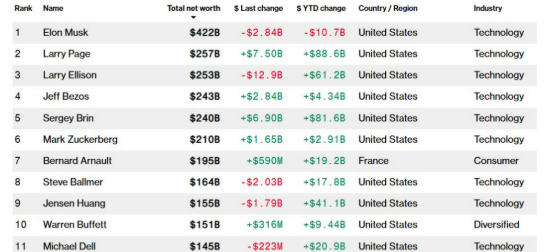


In the electrifying arena of global fortunes, where stock tickers flicker like digital lightning, Google co-founder Larry Page has vaulted past Amazon’s Jeff Bezos to claim the third spot on the world’s wealthiest list. As of November 24, 2025, Page’s net worth has surged to $252 billion, propelled by a 3% rocket in Alphabet shares following the unveiling of Gemini 3—the latest AI powerhouse from Google that promises razor-sharp responses to the thorniest queries without endless prompting. This leap, adding a cool $6 billion to Page’s coffers in a single day, underscores the AI boom’s ruthless reshuffling of billionaire rankings.
Bezos, once the unchallenged e-commerce emperor, slips to fourth at $240 billion, his empire buffeted by e-commerce headwinds and intensifying AI rivalries. As the tech vanguard hurtles toward trillion-dollar valuations, this seismic shift signals not just personal triumphs but a broader tectonic plate: artificial intelligence is minting fortunes at a velocity unseen since the dot-com delirium, potentially crowning Elon Musk as the planet’s first trillionaire by decade’s end. The top 10 wealthiest individuals, per the latest Bloomberg Billionaires Index and Forbes Real-Time rankings, form a constellation of innovation overlords, predominantly American, whose empires span software, semiconductors, and space. Collectively, these titans command over $2.4 trillion—a staggering sum that’s ballooned $100 billion in mere months, largely on AI’s turbocharged wings. Here’s the lineup, with their countries of origin and wealth engines:
- Elon Musk (United States, $422 billion): The South African-born polymath dominates via Tesla’s electric vehicle revolution and autonomous driving AI, SpaceX’s reusable rockets valued at $400 billion, xAI’s $80 billion frontier models, and X’s social media sway. Musk’s fortune, up $6 billion this month alone, embodies AI’s fusion with hardware.
- Larry Ellison (United States, $276.5 billion): Oracle’s co-founder built his dynasty on enterprise software, but AI cloud services have catapulted him to second place. His stake in the database giant, now a linchpin for AI data management, briefly dethroned Musk earlier this year before a $34 billion volatility dip.
- Larry Page (United States, $252 billion): Co-creator of Google, Page’s wealth stems from Alphabet’s search behemoth, YouTube, and Waymo’s self-driving tech. The Gemini 3 launch exemplifies how AI investments are supercharging his passive oversight role.
- Jeff Bezos (United States, $240 billion): The Blue Origin visionary amassed riches through Amazon’s e-commerce colossus and AWS cloud dominance, which powers much of the world’s AI infrastructure. Yet, retail slowdowns have tempered his ascent amid AI’s spotlight.
- Sergey Brin (United States, $233 billion): Page’s Google co-founder mirrors his partner’s profile—Alphabet’s AI-driven ecosystem, from search algorithms to quantum computing ventures, fuels Brin’s parallel fortune, boosted $5 billion post-Gemini.
- Bernard Arnault & Family (France, $211 billion): A luxury outlier, LVMH’s chairman (Louis Vuitton, Dior, Tiffany) derives wealth from high-end fashion and spirits. AI’s minimal direct touch keeps him stable, though personalization algorithms are infiltrating retail.
- Warren Buffett (United States, $180 billion): The “Oracle of Omaha” hoards value through Berkshire Hathaway’s diversified portfolio—insurance, railroads, and consumer goods like Coca-Cola. At 95, his old-school investing weathers AI storms via timeless compounding.
- Bill Gates (United States, $114 billion): Microsoft’s co-founder pivoted early to philanthropy, but his fortune endures from software licensing and stakes in Canadian National Railway. AI ethics via his foundation positions him as a thoughtful elder statesman.
- Michael Bloomberg (United States, $107 billion): The media financier’s Bloomberg Terminal—essential for traders dissecting AI market data—anchors his wealth, supplemented by NYC real estate and past mayoral clout.
- Carlos Slim Helú & Family (Mexico, $106 billion): Telecom titan América Móvil connects Latin America’s masses, with mining and construction sidelines. AI’s role is nascent, via network upgrades for data-heavy apps.

These moguls aren’t just rich; they’re architects of modernity, with nine Americans underscoring Silicon Valley’s gravitational pull. Their ascent? A cocktail of IPO windfalls, stock surges, and shrewd bets on disruptive tech.Peering five years ahead to 2030, AI’s explosion—projected to balloon the sector from $214.6 billion today to $1.3 trillion, per MarketsandMarkets—promises a wealth supernova. Nvidia’s Jensen Huang forecasts AI minting more millionaires in half a decade than the internet did in two, via supercomputers churning trillions in value. Bloomberg tallies 29 new AI billionaires already, with unicorns like Anthropic ($61.5 billion valuation) and OpenAI alumni spawning fortunes totaling $71 billion.
Expect seismic shifts: Tech scions like Musk, Page, and Ellison could double their hauls as AI permeates healthcare (drug discovery in days), finance (algorithmic trading), and manufacturing (robotic factories). Legacy players like Buffett may lag unless Berkshire dives deeper into AI adjacencies, while Arnault’s luxury realm could harness AI for bespoke consumer experiences, fending off erosion.Yet, perils loom. McKinsey warns AI could automate 30% of jobs by 2030, exacerbating inequality if wealth concentrates further—Bloomberg’s 498 AI unicorns, worth $2.7 trillion, signal a “billionaire boom” that risks social fissures. Regulatory tsunamis, from EU AI Acts to U.S. antitrust probes, might clip wings, but innovation’s momentum favors the bold. Deloitte’s trends spotlight “agentic AI” and “sovereign models,” turbocharging GDP by $19.9 trillion while birthing ethical quandaries Musk himself flags: a 20% annihilation risk if unchecked.At the vortex? Elon Musk, whose $422 billion perch teases trillionaire status. Projections vary—Kamal Ahmed eyes 2027 via Tesla’s Full Self-Driving, SpaceX’s Mars ambitions, and xAI’s superintelligence quest; Fox News pegs pre-2030 on compounding portfolios.
Musk’s own crystal ball: AI eclipsing all human intellect by 2030, rendering work “optional” and money “irrelevant” in a post-scarcity utopia. With Tesla’s $1 trillion comp package ratified, his 25%+ stake amplifies bets. Skeptics cite bubbles—dot-com echoes—but Musk’s track record (Tesla from $1 to $400/share) and AI’s inexorable march (surpassing single humans by 2026, per his All-In podcast) tilt odds favorably. By 2030, if xAI hits $500 billion and Starship colonizes orbits, Musk won’t just lead; he’ll redefine “wealth” amid AI’s gilded dawn.This AI-fueled oligarchy heralds progress and peril—a gilded age 2.0 where code crafts kings. As Page’s overtake illustrates, fortunes flip on a model’s whim, but the real wager is humanity’s share in the bounty.
Research Links
- The Top 10 Richest People In The World | November 2025
- Bloomberg Billionaires Index: List of Top 10 Billionaires in the World (Updated November 2025)
- The Bloomberg Billionaires Index is a daily ranking of the world’s richest people
- The 10 Richest People in the World
- Forbes 2025 Billionaires List – The Richest People In The World Ranked
- Top 10 richest people in the world 2025: Elon Musk likely to become history’s first trillionaire; check his net-worth
- Forbes Real Time Billionaires List – The World’s Richest People
- Google cofounder Larry Page overtakes Jeff Bezos as the third richest person in the world following an Alphabet stock surge
- Google Cofounder Larry Page Overtakes Bezos For World’s Third Richest After Gemini 3 AI Model Announcement
- Larry Page richest 2025: Larry Page overtakes Jeff Bezos to become the third richest person in the world – who is he?
- Larry Page Overtakes Jeff Bezos to Become World’s Third Richest Man as Gemini 3 Boosts Alphabet Shares
- Larry Page Surpasses Bezos as World’s Third-Richest on AI-Driven Surge
- Musk predicted to become world’s first trillionaire by 2030
- Elon Musk predicted to become world’s first trillionaire before 2030
- AI’s $19.9 Trillion Impact Could Create The First Trillionaire—But Mark Cuban Says It Won’t Be Musk Or Bezos
- Elon Musk predicts AI could surpass human intelligence by 2030
- AI is creating new billionaires at a record pace
- 29 New Billionaires Who Got Rich from the AI Boom
- AI will make the rich unfathomably richer. Is this really what we want?
- Nvidia CEO Jensen Huang says AI will create more millionaires in 5 years than the Internet did in 20
Sgt K and Luke at Whatfinger News










CLICK HERE FOR COMMENTS