

China Building World’s Largest Military Command Centre, 10x Bigger than Pentagon
Satellite images analysed by US intel allegedly expose a staggering 1,500-acre site near Beijing under construction since mid-2024.
A move that sparks global jitters 🤔pic.twitter.com/WZmXlgJynP
— Jaymin Shah (@JayminSOfficial) February 1, 2025
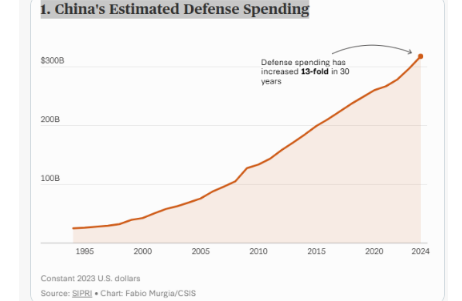
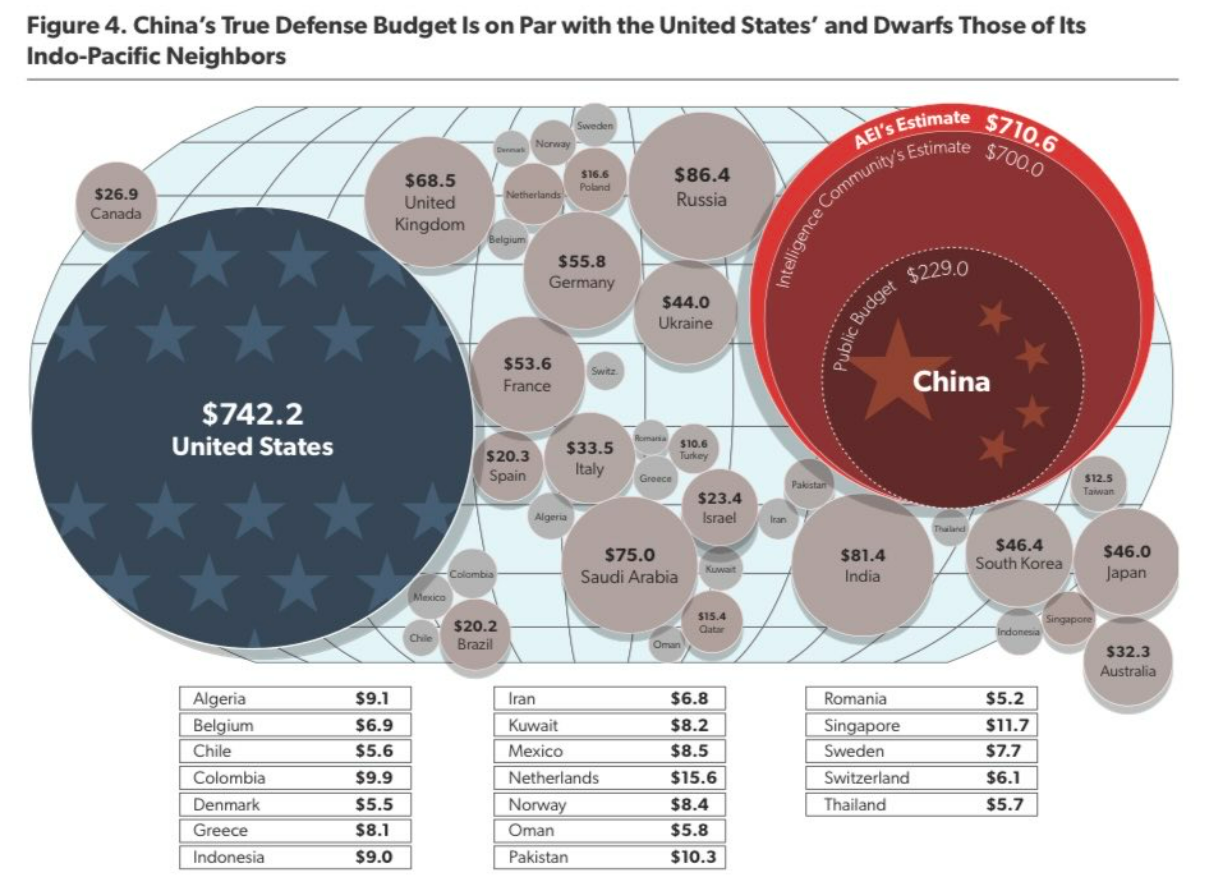
Expected to carry 90-100 aircraft, including cutting-edge J-35 stealth fighters and KJ-600 early warning planes, this Type 004 carrier represents more than just a ship—it’s a symbol of China’s relentless military modernization. As Beijing eyes Taiwan with increasing intensity, this surge in naval, nuclear, and air capabilities signals preparations for potential invasion and confrontation with any opposing forces, reshaping the global balance of power. The People’s Liberation Army Navy (PLAN) has undergone a transformation of unprecedented scale, evolving from a coastal defense force into the world’s largest navy by hull count. By 2025, the PLAN’s battle force is projected to reach 395 ships, expanding further to 435 by 2030, dwarfing the U.S. Navy’s current fleet of around 290 vessels.
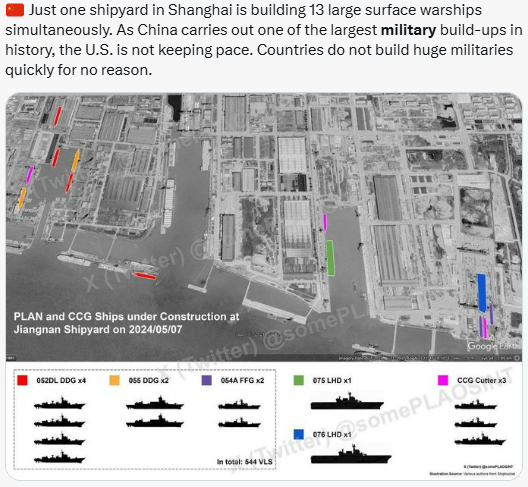
This growth is fueled by China’s shipbuilding prowess, which experts estimate at 200 times that of the United States, allowing Beijing to churn out warships at a “breakneck speed.” The fleet’s composition is equally impressive: modern destroyers like the Type 055, equipped with advanced radars and missiles; stealthy Type 095 nuclear submarines; and amphibious assault ships such as the Type 075, capable of launching helicopters and marines for island-hopping operations. Carrier aviation is taking center stage, with the third carrier, Fujian, already undergoing sea trials featuring electromagnetic launch systems superior in some aspects to U.S. equivalents. Reports suggest China could field six to seven carriers by the early 2030s, enabling blue-water operations far from home shores.
Results of the 14th Five-Year Plan: China shows the results of the modernization of the armed forces
🇨🇳 Results of the 14th Five-Year Plan: China shows the results of the modernization of the armed forces
china3army pic.twitter.com/vRXWaVGlc1
— dana (@dana916) October 10, 2025

🚨 CHINA’S NAVAL BEAST: TYPE 055 DESTROYER 🇨🇳⚓
China is fast-tracking its Type 055 guided missile destroyers — massive, multi-mission warships armed with 128 missiles and cutting-edge electronics.
Already 10 commissioned, more under construction, these apex predators are… pic.twitter.com/UOJTMVDh68
— Global Watch (@Global_Watch24) October 9, 2025
Links
- China’s navy is expanding at breakneck speed – BBC
- Report to Congress on Chinese Naval Modernization – USNI News
- The breakneck speed of China’s shipbuilding: How Chinese Navy is …
- China’s PLA Navy: A Peer Competitor Emerges – Geopolitical Monitor
- The PLA Navy Comes of Age: Big Decks and More | Proceedings
- “China Maritime Report No. 47: The People of China’s Navy and …
- China’s naval growth goes vertical | Lowy Institute
- Made In China 2025’s Impact on Chinese Shipbuilding
- Chinese Carrier Aviation Taking Off In 2025 – NavalNews
- Chinese nuclear weapons, 2025 – Bulletin of the Atomic Scientists
- Pentagon Says Chinese Nuclear Arsenal Still Growing
- China’s expanding nuclear arsenal raises fears of ‘Nuclear …
- Nuclear risks grow as new arms race looms—new SIPRI Yearbook …
- SPECIAL REPORT China’s growing nuclear arsenal – Reuters
- Chinese Nuclear Weapons, 2025 – Federation of American Scientists
- China is doubling its nuclear arsenal – how worried should we be?
- How Big Will China’s Nuclear Arsenal Get? – CNAS
- Could China’s New Nuclear Weapons Signal a New Era of Arms …
- Classified US intelligence warns of China’s preparations for Taiwan …
- China-Taiwan Weekly Update, October 10, 2025
- Satellite Photos Show China’s Mock Taipei City for Invasion Training
- A Wargame to Take Taiwan, from China’s Perspective
- Rethinking the Threat: Why China is Unlikely to Invade Taiwan
- How Russia is Helping China Prepare to Seize Taiwan – RUSI
- Taiwan to build air defence dome against ‘hostile threats’ – BBC
- Can Taiwan Survive if China Strikes for Real? – JAPAN Forward
- Russia Is Helping China to Prepare for a Potential Invasion of …
- Does China have the inclination and/or ability to invade Taiwan?
- China builds smaller but more capable air force – Defence Blog
- Rightsizing the PLA Air Force: Revisiting an Analytic Framework
- Mapping the Recent Trends in China’s Military Modernisation – 2025
- China’s Military in 10 Charts – CSIS
- [PDF] Military and Security Developments Involving the People’s Republic …
- China’s Stealth Fighter Air Force Is Nearing ‘Juggernaut Status’
- China’s Air Force: The Long March to Modernization – RAND
- Checking in on Modernization and Reforms in the People’s …
- China Military Studies Review – Marine Corps University
China’s J-20S: A Wake-Up Call for American Air Dominance in the Face of Rising Red Threats
Military News And Vids Daily – Whatfinger’s Military News Homepage – CLICK HERE
Sgt Pat and Mal Antoni at Whatfinger News
- Is Ivermectin the Key to Fighting Cancer? …. – Wellness (Dr. McCullough’s company) Sponsored Post 🛑 You can get MEBENDAZOLE and Ivermectin from Wellness 👍
- Be prepared for anything, including lockdowns with your own Emergency Med kit – see Wellness Emergency Kit (includes Ivermectin and other essential drugs, guide book, much more… peace of mind for you and your family) 🛑 – Dr. McCullough’s company! – Sponsor
- How can you move your 401K to Gold penalty free? Get the answer and more with Goldco’s exclusive Gold IRA Beginner’s Guide. Click here now! – Goldco
- The Truth About Weight Loss After 40 – Wellness Can Help You – Sponsor
- Facebook doesn’t want you reading most sites we link to or any vids or features that we post. Their algorithm hides our pages and humor too as best it can. The way to stick it to Zuckerberg? Sign up for our 3x a week or more newsletter. Takes 6 seconds. We send out the best – most popular links, no spam, plus a splash of honesty even beyond Whatfinger’s homepage…. – CLICK HERE
- Tackle Your Credit Card Debt by Paying 0% Interest Until 2027 – Sponsored
- Whatfingers Health Vids to help you live longer. DO NOT let Big Pharma and any Doctor kill you slowly because that is what their higher-ups want for $. Remember: Bad doctors live by this: Every patient cured is a patient lost’ – get it? The establishment, like RFK Jr says, wants to keep you sick and getting sicker for maximum profit. FIGHT – get the knowledge – CLICK HERE
- Hey Folks, We need a little help for server and security costs… If you can spare some and love what we do, Please CLICK HERE for our Donor box Support Fund. Or see next links… and buy us a coffee or 10, or 100 (we can hope… As we hate begging for contributions but this world is run by money 🙂 🛑
- Buy us a coffee – link – CLICK HERE












CLICK HERE FOR COMMENTS