
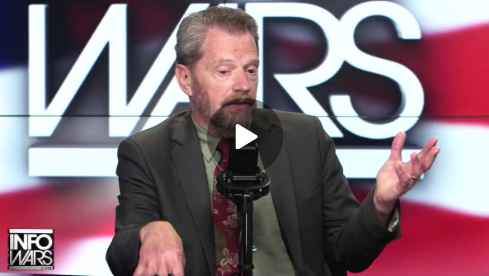

Article on it all is under this top video
The Mysterious Downfall of KAL 007: Did the US Deep State Collaborate with Russia to Assassinate Congressman Larry McDonald?
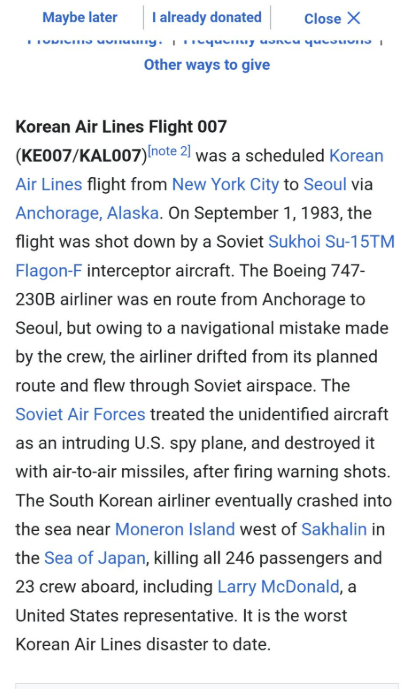
On September 1, 1983, Korean Air Lines Flight 007 (KAL 007), a Boeing 747 en route from Anchorage, Alaska, to Seoul, South Korea, was shot down by a Soviet Sukhoi Su-15 interceptor over the Sea of Japan, killing all 269 passengers and crew aboard. Among the victims was U.S. Congressman Lawrence “Larry” Patton McDonald, a staunch anti-communist Democrat from Georgia and the second president of the John Birch Society. The official narrative attributes the tragedy to a navigational error that led the plane into prohibited Soviet airspace, where it was mistaken for a U.S. spy plane amid heightened Cold War tensions.
However, conspiracy theorists, including prominent figures like Alex Jones, have long suggested a more sinister plot: that the U.S. Deep State colluded with the Soviet Union to eliminate McDonald, a vocal critic of globalist agendas and communism. As we mark over four decades since the incident, questions linger about navigational anomalies, suppressed evidence, and geopolitical motivations. This article explores the possibilities, weighing evidence for and against the conspiracy claims, drawing from mainstream investigations, declassified documents, and alternative viewpoints to present a multifaceted perspective. Larry McDonald was no ordinary politician. Elected to the House of Representatives in 1974, he was known for his unyielding opposition to communism and what he perceived as subversive forces within the U.S. government.
As chairman of the John Birch Society from 1983, McDonald frequently warned about a “New World Order” orchestrated by international elites, echoing themes that would later become staples in conspiracy discourse. He was en route to Seoul to commemorate the 30th anniversary of the U.S.-South Korea Mutual Defense Treaty when KAL 007 deviated from its path. McDonald’s prominence made him a target in the eyes of theorists; some speculate his rising influence—potentially even a path to the presidency—threatened powerful interests. Alex Jones, through his Infowars platform, has amplified this narrative, recently featuring William F. Jasper, a senior editor at The New American, who argues that the Deep State engineered McDonald’s demise in collaboration with Soviet forces.
Jones claims this was a deliberate act to silence a key opponent of globalism, correcting a minor error in dating but emphasizing the alleged conspiracy’s depth. The official account, as detailed in the 1993 International Civil Aviation Organization (ICAO) report, posits that KAL 007’s deviation resulted from a crew error in programming the inertial navigation system (INS). Shortly after takeoff from Anchorage, the plane strayed north of its intended route, crossing into Soviet airspace over the Kamchatka Peninsula and later Sakhalin Island. Soviet radars detected the intrusion during a period of intense military activity, including a missile test, and amid surveillance of a nearby U.S. RC-135 reconnaissance plane. Pilot Gennadi Osipovich, under orders, fired two missiles, believing it was a military intruder.
Declassified U.S. intelligence intercepts confirmed the Soviets’ confusion, with no indication of deliberate targeting of a civilian jet. The ICAO concluded there was no evidence of a spy mission, attributing the shootdown to Soviet overreaction rather than premeditation. This view is supported by experts like aviation analyst Christine Negroni, who notes similar navigation errors in pre-GPS era flights. Yet, conspiracy theories persist, fueled by inconsistencies and geopolitical context. Proponents argue the deviation was too precise to be accidental, suggesting KAL 007 was on a U.S.-orchestrated ferret mission to probe Soviet defenses. Books like R.W. Johnson’s “Shootdown” (1986) cite circumstantial evidence, such as the plane’s path over sensitive military sites and the presence of the RC-135, implying coordination.
David Pearson’s 1987 work in The Nation proposed the pilots knowingly intruded with U.S. intelligence knowledge. Michel Brun’s “Incident at Sakhalin” (1995) theorizes multiple aircraft were involved, with KAL 007 caught in a larger aerial confrontation. The absence of most bodies and wreckage—only small debris found near Moneron Island—raises suspicions of a cover-up. Soviet diver Valery Kamensky’s 2001 statement that bodies should have been recovered if the plane simply crashed adds intrigue. Jones’ narrative builds on this, positing Deep State-Soviet collusion to eliminate McDonald, whose exposés on elite cabals threatened exposure. Jasper links it to McDonald’s congressional probes into subversive activities. Some theories even suggest electronic jamming lured the plane off course.
Evidence supporting these claims includes the delayed release of black boxes by Russia in 1992, which showed no crew awareness of deviation but fueled tampering allegations. U.S. destruction of radar tapes from King Salmon, Alaska, within 30 hours, as admitted in court, suggests suppression. The RC-135’s proximity—Soviets reportedly confused the planes—implies possible mission overlap. Historian Alexander Dallin’s 1985 book “Black Box” argues the deviation defies simple error, hinting at intelligence involvement without direct proof. Oliver Clubb’s “KAL Flight 007: The Hidden Story” (1985) posits a spy operation, citing political embarrassment as a motive for cover-up. In a 1985 Los Angeles Times analysis, skeptics highlighted Japanese radar data distortions, though experts dismissed them as misinterpretations.
Bert Schlossberg’s “Rescue 007” (2001) claims survivors were imprisoned, based on alleged Siberian sightings. Countering these, mainstream sources emphasize debunking. The ICAO’s exhaustive review found no spy evidence; cockpit recordings show relaxed crew banter, inconsistent with a covert mission. Seymour Hersh’s “The Target Is Destroyed” (1986) concludes no U.S. involvement, attributing the shootdown to Soviet paranoia. Experts like Murray Sayle criticized Pearson’s theories as riddled with errors on aviation tech. U.S. officials, including former Pentagon sources, argue risking civilians for intelligence was unnecessary given existing surveillance capabilities. The 1993 black box handover confirmed no tampering, supporting accidental deviation.
- Facebook doesn’t want you reading most sites we link to or any vids we post. Their algorithm hides our pages and humor too as best it can. The way to stick it to Zuckerberg? Sign up for our once-a-day newsletter. Takes 6 seconds. We send out the best – most popular links daily, no spam, plus a splash of honesty even beyond Whatfinger’s homepage…. – CLICK HERE
Conspiracy lists often include KAL 007 as a debunked theory, akin to chemtrails. Attorney Juanita Madole, representing victims’ families, dismissed imprisonment claims as wishful thinking.
Alex Jones’ angle ties into broader Deep State narratives, linking to QAnon-like theories. The possibilities remain tantalizing. If a navigation error, it underscores human fallibility in high-stakes aviation. If collusion, it exposes shadowy alliances transcending ideologies. Evidence leans toward accident, with conspiracies relying on circumstantial gaps. Yet, missing wreckage and delayed disclosures ensure debate endures. As Dallin noted, time strengthens some arguments, but without new revelations, KAL 007’s truth may forever elude us.
Links
- The Death Flight of Larry McDonald
- Rep. McDonald dies when Soviets shoot down Boeing 747, Sept. 1, 1983
- The Destruction of Flight KAL007 and the Death of Representative Larry McDonald of Georgia
- KAL 007: A Targeted Assassination?
- The Death Flight of Larry McDonald
- Korean Air Lines Flight 007
- KAL 007
- Soviets shoot down airliner carrying Rep. Larry McDonald, Sept. 1, 1983
- Your thoughts on the USSR killing Congressman Larry McDonald in KAL007
- Lawrence Patton McDonald congressional papers
- A Shot in the Dark: The Untold Story of Korean Air Lines flight 007
- Lawrence Patton McDonald
- FRI-10 REP. LARRY MCDONALD
- KAL Flight 007
- Learn How The US Deep State Worked With Russia To Kill Congressman Larry McDonald
- Learn How The US Deep State Worked With Russia To Kill Congressman Larry McDonald
- New World Order conspiracy theory
- The HON. LARRY McDONALD
- QAnon
- In the Shadow of the Cold War: Structural Analysis on US-Russia Relations
- There’s a War on For Your Mind!
- Have any of Alex Jones’s conspiracy theories ended up being true or somewhat true?
- Putin’s asymmetric assault on democracy in Russia and Europe
- The mccarthy-hearings-volume1.pdf
- Meeting Public Comments
- Technological Possibilities for Democracy
- COVID-19: Fear, quackery, false representations and the law
- BU Historian Answers: Are We Headed for Another Civil War?
- Conspiracy Theory and the Society of the Cincinnati, 1783-1790
- Theories persist on KAL 007 shootdown
- The Downing of KAL Flight 007
- Korean Air Lines flight 007
- The KAL 007 Shootdown
- The KAL 007 Shootdown
- A Shot in the Dark: The Untold Story of Korean Air Lines flight 007
- KAL 007: A Targeted Assassination?
- Statement on KAL-007 – Sept. 6, 1983
- Korean Air Lines Flight 007 alternative theories
- KAL Conspiracy Theorists Distort Facts, Experts Say
- Defense
- THEORIES AND CONSPIRACY THEORIES
- Theories persist on KAL 007 shootdown
- r/ForAllMankindTV on Reddit: Do you think USA used the KAL 007 flight as a spy plane in season 2?
- KAL Flight 007: A Cold War-fueled tragedy
- List of conspiracy theories

- Is Ivermectin the Key to Fighting Cancer? …. – Wellness (Dr. McCullough’s company) Sponsored Post 🛑 You can get MEBENDAZOLE and Ivermectin from Wellness 👍
- Be prepared for anything, including lockdowns with your own Emergency Med kit – see Wellness Emergency Kit (includes Ivermectin and other essential drugs, guide book, much more… peace of mind for you and your family) 🛑 – Dr. McCullough’s company! – Sponsor
- How can you move your 401K to Gold penalty free? Get the answer and more with Goldco’s exclusive Gold IRA Beginner’s Guide. Click here now! – Goldco
- The Truth About Weight Loss After 40 – Wellness Can Help You – Sponsor
- Facebook doesn’t want you reading most sites we link to or any vids we post. Their algorithm hides our pages and humor too as best it can. The way to stick it to Zuckerberg? Sign up for our once-a-day newsletter. Takes 6 seconds. We send out the best – most popular links daily, no spam, plus a splash of honesty even beyond Whatfinger’s homepage…. – CLICK HERE









CLICK HERE FOR COMMENTS